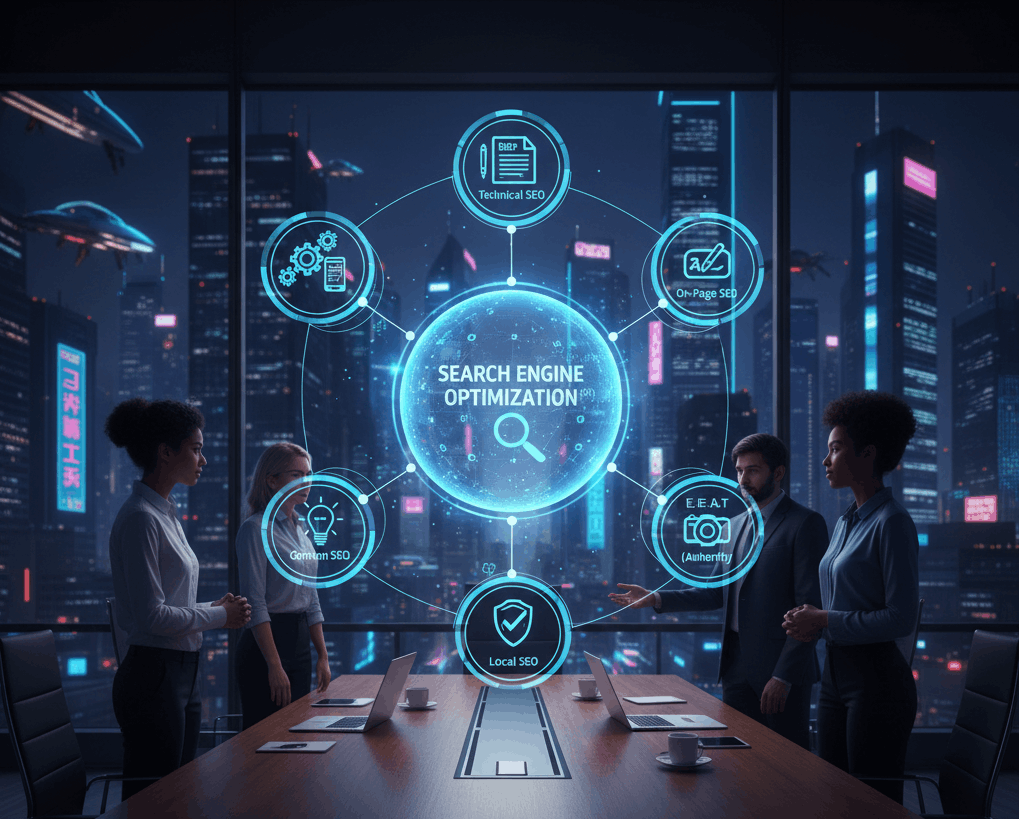

As someone who’s spent over a decade building and auditing search strategies for businesses ranging from solo consultants to mid-market SaaS companies, I can tell you this: most people underestimate SEO. Not because they don’t know it exists, but because they think it’s just about “ranking on Google.” It’s not. The benefits of SEO touch revenue, trust, user experience, and local foot traffic in ways that still surprise even seasoned marketers.
Here’s what the numbers actually show, what’s changed since the AI search shake-up, and why search engine optimization remains the single highest-ROI marketing channel heading into 2026.
Page Contents
What Is SEO, and Why Does It Still Matter?
Search engine optimization (SEO) is the practice of improving a website’s visibility in organic (non-paid) search results across engines like Google, Bing, and increasingly, AI-powered platforms like ChatGPT and Perplexity. It works by aligning your site’s content, technical structure, and authority signals with what search algorithms reward, so your pages appear when real people search for what you offer.
That might sound basic. But consider the scale: according to Statista, Google alone processes roughly 8.5 billion searches per day. And according to a 2025 SE Ranking analysis, organic search still represents nearly 47% of all website traffic globally. That’s more than paid ads, social media, email, and direct traffic combined. Even with AI Overviews reshaping how results appear, a January 2026 Graphite study using Similarweb data from over 40,000 top U.S. websites found organic traffic declined just 2.5% year over year, not the catastrophic 25-60% drops you’ll see in breathless LinkedIn posts.
SEO isn’t dying. It’s evolving. And the businesses that understand how it’s evolving are the ones pulling ahead.

Why Most Businesses Are Leaving Money on the Table
Let me back up for a second. I audited a mid-sized e-commerce brand last year that was spending $14,000/month on paid ads and $0 on SEO. Their Google Ads were generating a 3.2x return. Not bad. But when we layered in a focused SEO strategy targeting their top 40 commercial keywords, organic revenue jumped 41% within eight months, and their blended customer acquisition cost dropped by a third.
That’s not an outlier. According to FirstPageSage’s 2025 industry analysis, SEO delivers an average ROI of 702% for B2B SaaS businesses. Real estate companies? A staggering 1,389%. Meanwhile, organic leads convert at a 14.6% rate compared to just 1.7% for traditional outbound methods, per SeoProfy’s 2025 data. The search engine optimization ROI isn’t theoretical. It’s measurable, and it compounds over time unlike paid channels where the moment you stop spending, the traffic stops.
Sound familiar? You’re paying for clicks, but your organic presence is a ghost town.
Here’s the thing most agencies won’t tell you: 94% of all web pages receive zero traffic from Google, according to SE Ranking’s 2025 audit. Not low traffic. Zero. That means the opportunity gap is enormous if you’re willing to do the work. And while competitors fixate on vanity metrics like impressions, the businesses winning in 2026 are tracking revenue contribution from organic search and optimizing accordingly.
How SEO Drives Organic Traffic Growth (A Practical Framework)
Talking about SEO for organic traffic growth in abstract terms doesn’t help anyone. So here’s the four-stage framework I use with clients, and it works whether you’re a local bakery or a venture-backed startup.
Stage 1: Technical Foundation
Before you write a single word of content, your site needs to load fast, render properly on mobile, and be crawlable by search engines. Google’s Core Web Vitals still matter. Pages that load in under 2.5 seconds see significantly higher engagement. Mobile devices now account for over 62% of global web traffic according to Statista’s 2025 data, so if your site looks broken on a phone, you’re invisible to the majority of searchers.
(Yes, I’ve seen six-figure websites with broken mobile layouts. More often than you’d think.)
Stage 2: Strategic Keyword Mapping
Don’t just chase high-volume keywords. Map search intent across your buyer journey: informational queries for awareness (“what is local SEO”), commercial queries for consideration (“best SEO tools for small business”), and transactional queries for conversion (“hire SEO agency Chicago”). According to SE Ranking, 34.71% of Google search queries contain four or more words, so long-tail phrases are where a lot of the real opportunity lives.
Stage 3: Content That Earns Authority
This is where improving user experience through SEO becomes tangible. Google’s helpful content system rewards pages that demonstrate genuine expertise, provide clear answers, and keep visitors engaged. According to FirstPageSage’s 2025 click-through-rate study, the #1 organic result captures 39.8% of clicks. Position #2 drops to 18.7%. Position #10? You’re fighting for scraps. The content that earns top positions is comprehensive, well-structured, and written for humans first.
Stage 4: Measurement and Iteration
Here’s where most businesses stall. They publish content, wait, and then wonder why nothing happened. SEO compounds, but it requires iteration. Track keyword rankings, organic sessions, conversion events, and (critically) revenue attribution. A 2025 Conductor study found that 91% of SEO practitioners reported positive impact on website performance and marketing goals, but only when they treated SEO as an ongoing process, not a one-time project.
SEO vs. Paid Ads vs. Social Media: Where Should You Invest?
I get this question constantly. And the honest answer is: it depends on your timeline and budget. But the data tilts heavily toward organic search for long-term growth.
Organic SEO generates over 1,000% more traffic than social media marketing, according to Incremys’ 2026 analysis. It compounds. An article you publish today can drive traffic for years. The downside? It takes 6-12 months to see meaningful ROI on a new SEO campaign.
Paid search (Google Ads, Bing Ads) delivers immediate visibility but at a cost that only increases as competition grows. The moment you pause spend, traffic drops to zero. There’s no residual value.
Social media drives brand awareness and community engagement but accounts for just 10.12% of global traffic according to SE Ranking. It’s valuable, but it’s not a search replacement.
Here’s my contrarian take: the best strategy isn’t choosing one. It’s using paid ads for immediate revenue while building organic authority that eventually reduces your dependence on paid channels. I’ve watched clients cut their ad spend by 50% after 18 months of consistent SEO work, with total revenue actually increasing. That moment when organic starts outperforming paid? Pure gold.
One myth worth addressing: some business owners believe SEO is “free.” It’s not. It requires investment in content, technical optimization, and often outside expertise. But unlike paid media, that investment builds an asset you own.
Building Brand Credibility and Trust Through E-E-A-T
When your website appears on page one of Google’s search results, it sends an implicit trust signal to users. People don’t consciously think about it, but they associate high rankings with credibility, the same way a restaurant packed with diners feels safer than an empty one.
Google has formalized this concept through its E-E-A-T framework (Experience, Expertise, Authoritativeness, Trustworthiness), which is central to how the search quality raters at Alphabet evaluate content. Building brand credibility and trust through E-E-A-T isn’t optional anymore; it’s table stakes. Google’s Search Quality Evaluator Guidelines specifically call out content quality as a critical ranking factor, and sites that demonstrate real-world experience (the first “E”) consistently outperform generic content.
What does this look like in practice? Author bios with verifiable credentials. Citations from reputable sources. Content reviewed or written by subject matter experts. Customer reviews prominently displayed. According to BrightLocal’s 2025 research, customers are 2.7 times more likely to trust a business with a complete Google Business Profile. And 62% of consumers will actively avoid a business if they find incorrect information online.
As Lily Ray, VP of SEO Strategy and Research at Amsive, has noted in multiple industry talks, Google’s systems are getting significantly better at identifying which content comes from genuine practitioners versus content mills. If you’re not investing in demonstrating real expertise, your competitors who do will steadily take your rankings.
Local SEO Benefits for Small Businesses: The Overlooked Growth Engine
Here’s where things get really interesting for brick-and-mortar businesses and service providers. Nearly 46% of all Google searches carry local intent, according to data Google itself has shared. That’s billions of searches where someone is looking for a product, service, or business near them.
The local SEO benefits for small businesses are concrete and immediate. According to Google’s own data, 76% of people who perform a local search on their smartphone visit a physical store within 24 hours. And 88% of consumers who do a local search on their phone visit or call a store within a day, per SeoProfy’s 2025 compilation.
I worked with a dental practice in Austin, Texas that hadn’t touched their Google Business Profile in two years. We updated their hours, added 35 new photos, responded to every review, and optimized their service pages for neighborhood-specific keywords. Within four months, appointment requests through their Google profile tripled. No paid ads involved.
The businesses showing up in Google’s Local 3-Pack (those top three map results) receive 126% more traffic and 93% more actions like calls and website clicks compared to positions 4-10, according to SeoProfy’s local SEO research. Yet 58% of businesses still don’t have local SEO as part of their strategy, per ReviewTrackers. That’s a massive competitive gap.
If you’re a small business owner and you haven’t claimed, verified, and fully optimized your Google Business Profile, stop reading this article and go do that first. Seriously. It’s free, and it might be the single most impactful marketing move you make this quarter.
FAQs About the Benefits of SEO
How long does SEO take to show results? Most businesses see measurable improvements within 6 to 12 months of consistent effort. Quick wins like fixing technical errors or optimizing Google Business Profiles can show impact within weeks, but sustainable organic traffic growth requires ongoing content creation and authority building.
Is SEO still worth it with AI Overviews taking over search? Yes. While AI Overviews now appear for a growing share of queries, organic search still drives nearly 47% of all website traffic. A January 2026 Graphite analysis found organic traffic dropped only 2.5% year over year across 40,000+ U.S. sites. SEO is adapting, not disappearing.
What’s the average ROI of SEO compared to paid advertising? SEO delivers significantly higher long-term returns. B2B SaaS companies see an average ROI of 702%, while organic leads convert at 14.6% versus 1.7% for outbound. The key difference is that SEO builds compounding equity, paid ads don’t.
Can small businesses compete with big brands through SEO? Absolutely. Local SEO specifically levels the playing field. A well-optimized small business can dominate its geographic area in search results, regardless of the big brand budgets in its industry. The 46% of searches with local intent represent an opportunity most large companies underserve.
How does SEO improve user experience on my website? Good SEO requires fast page load times, mobile-friendly design, clear navigation, and helpful content. These improvements benefit both search engines and your visitors. Sites that meet Google’s Core Web Vitals benchmarks tend to see lower bounce rates and higher engagement.
Do I need to hire an SEO agency, or can I handle it myself? For basic optimization like claiming your Google Business Profile, writing quality content, and fixing technical issues, many business owners can handle things themselves with free tools like Google Search Console. For competitive industries or larger sites, professional help accelerates results.
What to Do Next
After years of watching businesses of all sizes struggle with, then succeed at, search optimization, here’s what I keep coming back to:
First: Don’t treat SEO as a project with an end date. The businesses winning in organic search treat it as an ongoing operational function, just like sales or customer service.
Second: Start with what you can measure. Connect your SEO efforts directly to revenue, not just rankings or traffic numbers. A Conductor study found 91% of SEO practitioners reporting positive business impact, but only those tracking the right metrics could prove it.
Third: Think local, even if you’re not local-only. Almost half of all searches have geographic intent, and optimizing for your area gives you a foothold that’s hard for distant competitors to challenge.
The benefits of SEO extend far beyond where your website shows up on a search results page. They touch how customers perceive your brand, how easily they find your storefront, and ultimately, whether they choose you or the business that showed up first.
Start with a free technical audit using Google Search Console, and subscribe to our newsletter for weekly search strategy updates.

Pingback: Cost-Effective ReactJS Development Services for Startups