
Here’s a number that should stop you cold: 5.66 billion social media user identities exist as of early 2026, according to DataReportal’s latest analysis. That’s roughly 70% of every person on Earth—scrolling, posting, buying, arguing, learning, and connecting. And yet, I still meet business owners who say “social media doesn’t work for us.”
I get the skepticism. As a digital strategist at Acroan who’s managed social campaigns for over seven years, I’ve seen brands waste money on strategies that looked good on paper and tanked in practice. But I’ve also watched a three-person startup turn a single TikTok reply into 40,000 followers in nine days. The difference? Understanding which benefits of social media actually matter in 2026—and which ones are recycled advice from 2019.
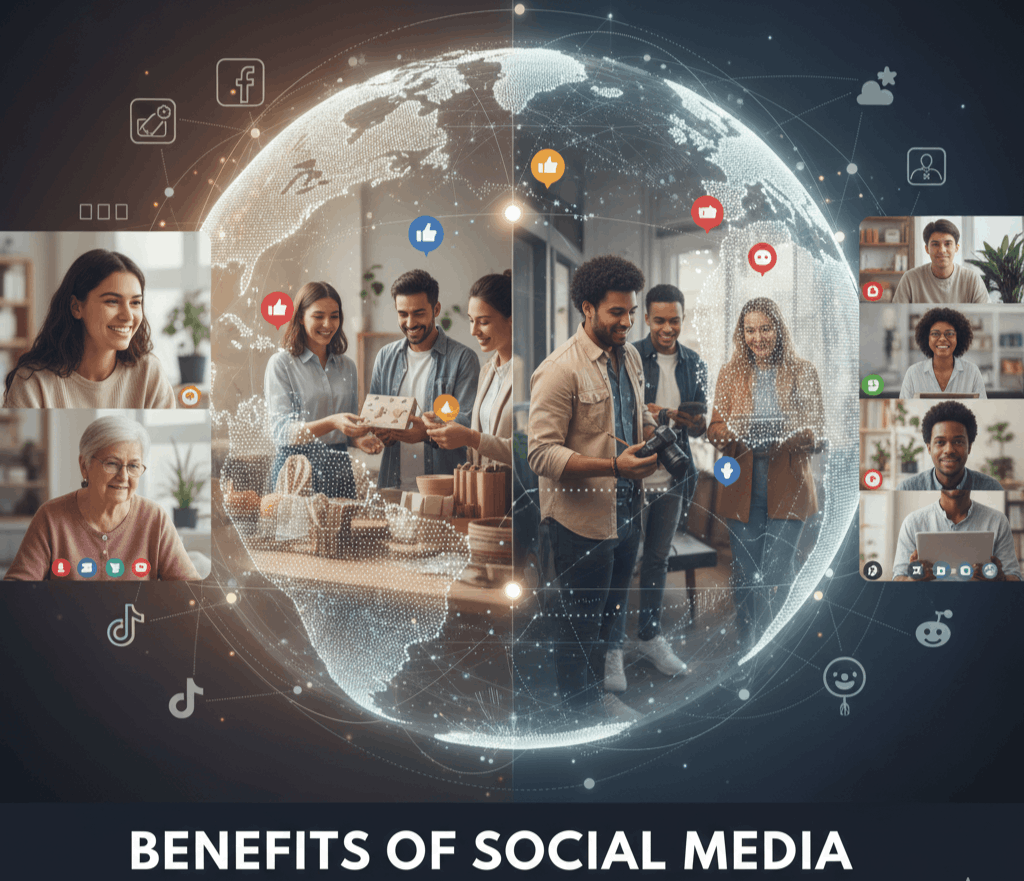
The benefits of social media include global audience reach, real-time customer service, community building, brand authority through social proof, mental health support through online communities, and social search capabilities that rival traditional search engines. In 2026, social platforms serve as discovery engines, shopping channels, and customer service desks—not just content distribution tools. With 5.66 billion users spending an average of 2 hours and 23 minutes daily across 7–8 platforms, social media is now core infrastructure for businesses and individuals alike.
Page Contents
Why I Think Most “Benefits of Social Media” Articles Get It Wrong
Google “benefits of social media” and you’ll find the same tired list everywhere. Increased brand awareness. Global reach. Cost-effective marketing.
None of that’s wrong, exactly. It’s just incomplete—frozen in 2020. The conversation has moved. Sprout Social’s 2026 State of Social report found that consumers now want brands to prioritize human-generated content above everything else. Fifty-five percent of social users said they’re more likely to trust brands that publish content made by actual people—not AI—and that number jumps to two-thirds among Gen Z and Millennials.
Meanwhile, social media has evolved into something most articles don’t cover: a search engine. Nearly three-quarters of internet users aged 16+ now research products on social platforms before purchasing. TikTok’s growth as a discovery engine means younger users are bypassing Google entirely for product research, restaurant recommendations, and news. That’s not a “benefit” most lists mention. But it’s where the real money is.
So let’s talk about what actually matters right now.
How Social Media Became the Best Customer Service Tool Nobody Expected
Social media as a customer service tool isn’t new. But in 2026, it’s no longer optional—it’s expected.
According to Sprout Social’s data, 73% of social users say they’ll buy from a competitor if a brand doesn’t respond on social. Let that sink in. Almost three-quarters of your potential customers will walk—not because your product is bad, but because you were too slow to reply to an Instagram DM.
I watched this play out with a mid-size e-commerce client in late 2025. They were hemorrhaging customers despite great products and competitive pricing. The culprit? Average response time on Facebook Messenger was 14 hours. We cut it to under 90 minutes using a simple triage system (human first, AI assist second). Revenue from social-referred customers jumped 31% in two months.
The bigger shift is that social customer service is now public. When you resolve someone’s complaint in a comment thread, everyone watching sees it. That’s social proof in action—you’re not just fixing a problem, you’re building brand authority with every visible interaction. The Zendesk CX Trends Report for 2026 notes that customers now see clear differences between companies that use AI effectively for social support and those that don’t.
Social Media for Community Building: The Benefit That Pays Compound Interest
Here’s the benefit most businesses undervalue: community.
Not followers. Not impressions. Community—meaning people who talk to each other, not just to you.
Greg Swan, Senior Partner at FINN Partners, captured it perfectly in Sprout Social’s 2026 predictions report: “The future of social media for brands will re-center community, not just content. People want connection, transparency, and real value.” And he’s right. Power Digital’s 2026 State of Social report backs this up: pinned replies, creator endorsements, and social proof now convert as effectively as traditional ads.
What does this look like in practice? Take Lodge Cast Iron, which manages a 40,000-member Facebook Group. Members share recipes, troubleshoot seasoning issues, and evangelize the brand—without Lodge paying a cent in ad spend for those conversations. Or look at how Discord communities and Reddit threads have become the go-to spaces for product feedback, where consumers migrate when they want real, unfiltered opinions.
Sprout Social’s Q4 2025 Pulse Survey found that interacting with audiences in smaller digital spaces is one of the top five things global users want brands to prioritize in 2026. The message is clear: stop broadcasting and start participating. (Trust me, I learned this the hard way managing a brand account that posted daily but responded to comments never.)
The Impact of Social Proof on Brand Authority—And Why UGC Is Your Secret Weapon
Social proof used to mean a nice testimonial page on your website. In 2026? It’s everything.
Power Digital’s research shows that over half of shoppers need 2–3 trust-building touchpoints before converting—usually user-generated content (UGC), influencer posts, or reviews. The shift is fundamental: consumers no longer trust before they verify. They verify before they trust.
The data on influencer marketing reinforces this. Creator-led ads now deliver nearly 2x the click-through rate of brand-produced creative, with 25% lower cost-per-click. That’s not a small edge—it’s a structural advantage. And in 2026, brands are projected to spend more on influencer marketing than on digital ads for the first time, which signals how deeply trust has shifted from institutions to individuals.
What does this mean for your social media strategy? Three things:
- Treat user-generated content as a performance channel, not a nice-to-have. Encourage customers to share their experiences and amplify those posts.
- Invest in micro-influencers with engaged audiences rather than chasing vanity metrics from mega-influencers. Smaller reach, higher trust.
- Turn your comment sections into conversation hubs. The sale is increasingly won or lost in the replies.
Benefits of Social Media for Mental Well-Being: What the Research Actually Says
This one’s complicated—and I’m not going to pretend otherwise.
The narrative around social media and mental health has been overwhelmingly negative. But the research tells a more nuanced story. A nationally representative longitudinal study published in the National Academies Press (NCBI), which followed children ages 10–13 over eight years, found that time spent on social media was not associated with depression or anxiety. The researchers concluded that “far more adolescents have positive or neutral experience on social media than negative.”
A Pew Research survey echoes this: over 90% of teens aged 13–17 reported that social media has a positive or neutral effect on their lives. The benefits include maintaining friendships, accessing support communities (especially for marginalized youth), and learning new skills. For adults, platforms like Reddit and Facebook Groups serve as lifelines for people dealing with chronic illness, grief, career transitions, and parenting challenges.
But here’s where honesty matters: these benefits are dose-dependent. Excessive scrolling—the mindless, 2 AM variety—correlates with anxiety and FOMO. The key variable isn’t whether you use social media, but why and how. Intentional use (connecting, creating, learning) tends to boost well-being. Passive consumption (comparing, doomscrolling, lurking) tends to hurt it. The platforms aren’t the villain. The habits are.
Advantages of Social Search for Business: The Benefit Nobody’s Talking About Enough
Here’s the shift that should change how you think about social media entirely: social platforms are becoming search engines.
The Motion Agency’s 2026 analysis found that nearly three-quarters of internet users aged 16+ use social media to research products before buying—with Instagram leading the way and LinkedIn gaining traction. TikTok has solidified its role as a discovery engine, with many users under 30 searching TikTok instead of Google for restaurants, travel tips, and product reviews.
For businesses, the advantages of social search are massive. Your social content now competes for the same consumer attention that Google once monopolized. That means:
- SEO and social are converging. Captions, hashtags, and profile bios are searchable discovery points. Optimize them like you’d optimize a web page.
- Video content is now search content. A well-titled TikTok or YouTube Short can rank for queries your blog never reached.
- Reviews and comments function as search results. Facebook (40%) and YouTube (34%) are the top platforms consumers use for reading reviews, according to Sprout Social’s 2026 statistics.
If you’re only thinking about social media as a content distribution channel, you’re leaving discoverability on the table.
Frequently Asked Questions About the Benefits of Social Media
What are the main benefits of social media for businesses in 2026?
The biggest business benefits include audience reach (5.66 billion users globally), real-time customer service, social commerce (17% of all online sales in 2025 came through social platforms), brand authority via social proof, and product discovery through social search. In 2026, social is also a primary tool for competitive intelligence and customer feedback.
Is social media actually good for mental health?
The research is more positive than headlines suggest. A longitudinal study via NCBI found no link between social media use and depression in young people over eight years. Over 90% of teens report positive or neutral effects. The key factor is intentional versus passive use—connecting and creating helps; mindless scrolling doesn’t.
How does social media work as a customer service tool?
Brands use platforms like Facebook Messenger, Instagram DMs, and X (Twitter) to handle support requests in real time. According to Sprout Social, 73% of consumers will buy from a competitor if a brand doesn’t respond on social. The best approach combines human agents with AI-assisted triage for speed and empathy.
What is social proof and why does it matter for brand authority?
Social proof is the psychological phenomenon where people look to others’ behavior to guide decisions. On social media, this includes UGC, reviews, influencer endorsements, and engagement metrics. Power Digital’s 2026 report shows that UGC and creator content now convert as effectively as traditional advertising.
Can social media replace Google for product research?
For younger demographics, it already has. TikTok and Instagram are primary discovery engines for Gen Z shoppers. Nearly 75% of internet users aged 16+ research products on social before buying. Social isn’t replacing Google entirely, but it’s claiming a growing share of the research journey.
What are the benefits of social media for community building?
Social platforms enable brands to build owned communities through Groups, Discord servers, and broadcast channels. These spaces drive loyalty, reduce support costs (members help each other), and generate organic content. Sprout Social’s research shows that community interaction is a top-five brand priority consumers want in 2026.
Is it worth investing in social media in 2026?
Yes. Global digital ad spending is projected to reach $678.7 billion in 2025, with social platforms capturing a significant share. Influencer marketing is overtaking traditional digital ads in spend. And with 81% of consumers making impulse purchases driven by social media multiple times per year, the ROI case has never been stronger—if you show up authentically.
What’s the biggest mistake businesses make with social media?
Broadcasting without engaging. Posting content but never responding to comments, DMs, or mentions. In 2026, the brands winning on social are the ones having conversations, not delivering monologues. Show up where your audience is talking—not just where your content performs.
What Actually Matters: Three Takeaways You Can Use Today
After seven years running social campaigns and tracking every platform shift, here’s what I keep coming back to about the benefits of social media in 2026:
One: Social isn’t a megaphone anymore—it’s a conversation. The brands seeing the highest ROI are the ones responding, not just posting. Customer service, comment engagement, and community building are where trust gets built.
Two: Social search is real. Treat your social profiles, captions, and video titles like search-optimized assets. Your next customer might find you through a TikTok search, not a Google one.
Three: Human content wins. In a world where AI-generated posts are proliferating, consumers are actively seeking authentic, human-created content. Fifty-five percent of users trust human content more—and that number is climbing.
Whether you’re a solo entrepreneur or managing a team of fifty, these benefits compound over time. Start with one platform, engage genuinely, and measure what matters.
What’s been your experience with social media this year? I’d love to hear what’s working (or what’s not) in the comments below.



Pingback: How to Choose Right Digital Marketing Agency: 5 Questions
Pingback: How to Align Your Content Marketing and Inbound Marketing Efforts