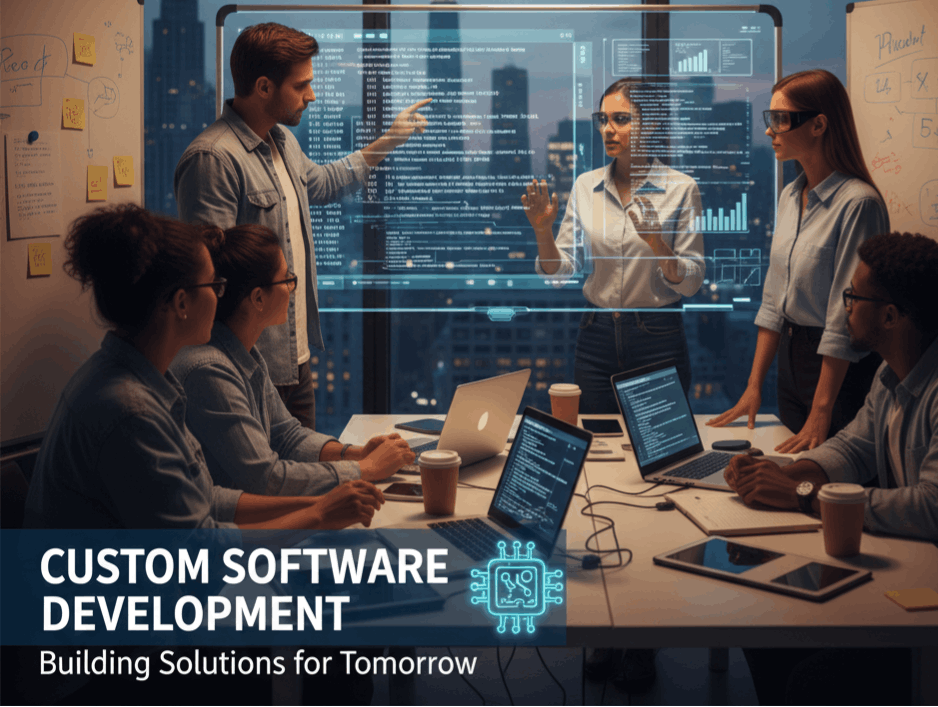

Here’s something that caught me off guard last year: a $43 billion industry is growing at nearly 23% year over year, and most business leaders I talk to still can’t explain the difference between custom software and a SaaS subscription. The custom software development market, valued at $53.02 billion in 2025 according to Precedence Research, isn’t just growing—it’s accelerating. And the reasons go way beyond what most articles will tell you.
I’ve spent the past decade helping organizations navigate the build-vs-buy question, and I can tell you this: the conversation has fundamentally changed since 2023. AI integration, legacy system debt, and rising SaaS fatigue have created a perfect storm where custom software development isn’t a luxury anymore. It’s often the only rational move. Let me walk you through what’s actually happening—the costs, the tradeoffs, the mistakes I see teams make—and why the old playbook no longer works.
Page Contents
What Is Custom Software Development, Really?
Custom software development is the process of designing, building, and maintaining software tailored to a specific organization’s workflows, data models, and business logic. Unlike off-the-shelf products built for broad audiences, bespoke software solutions address the exact requirements of your team, your customers, and your competitive positioning. According to Grand View Research, the global market reached $43.16 billion in 2024 and is projected to hit $146.18 billion by 2030—a 22.6% compound annual growth rate.
But let me be blunt: most definitions stop there, and that’s where the problems start.
Why Off-the-Shelf Software Is Failing More Companies Than Ever
I talk to CTOs every week who are drowning in SaaS subscriptions. Twelve tools for one department. Annual costs creeping past six figures. And the irony? They’re still using spreadsheets to bridge the gaps between all those “integrated” platforms.
The custom software vs off-the-shelf debate used to be straightforward: buy if it exists, build if it doesn’t. That logic assumed off-the-shelf tools would keep pace with your operations. They haven’t.
A 2025 survey of over 500 U.S. IT professionals by Saritasa found that 62% of organizations still rely on legacy software systems, with 43% citing security vulnerabilities as a primary concern. And here’s the kicker: half of them haven’t upgraded simply because “the current system still works.” Sound familiar?
Meanwhile, Gartner estimates that companies spend roughly 40% of their IT budgets on technical debt—maintaining systems that are actively slowing them down. The U.S. Government Accountability Office reported in 2025 that the ten federal legacy systems most in need of modernization cost approximately $337 million annually just to keep running. If the federal government can’t ignore the problem, neither can your business.
Custom Software Development Costs: What Nobody Tells You
Let’s talk numbers, because this is where most articles either oversimplify or dodge the question entirely.
Custom software development costs in 2026 typically range from $50,000 to $250,000+ for mid-complexity projects. But that range is almost meaningless without context. A basic MVP might cost $15,000–$50,000. An enterprise platform with AI features, multiple integrations, and compliance requirements? Easily $300,000 to $500,000 or more.
What really matters—and what I wish more people understood—is total cost of ownership. The initial build represents just 20–50% of a project’s lifetime investment. Post-launch maintenance, updates, and infrastructure typically run 15–25% of the initial development cost every single year. Factor that in before you sign anything.
The Hidden Cost Drivers Most Teams Miss
- Integration complexity: Connecting to legacy systems can extend timelines by 30–50%. Each third-party integration adds $2,000–$10,000.
- AI features: AI-powered functionality adds 10–20% to the development budget for mid-to-large projects.
- Communication overhead: Distributed teams lose 25–30% of productive capacity to coordination—a cost nobody budgets for.
- Optimism bias: Teams underestimate task complexity roughly 40% of the time. That’s not a guess; it’s a pattern I’ve tracked across dozens of projects.
Here’s my honest advice: if a vendor gives you a fixed quote after a 30-minute call, run. Accurate estimates require discovery phases, and that discovery phase itself is a genuine investment—but one that saves you from budget explosions down the line.
The Software Development Life Cycle: How Custom Projects Actually Get Built
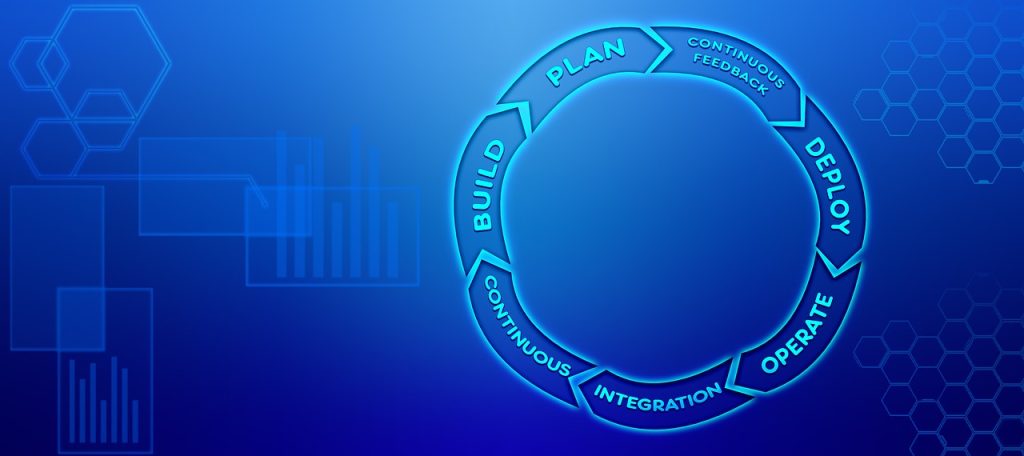
The software development life cycle (SDLC) isn’t just a textbook framework—it’s the difference between a product that ships and one that stalls at 60% completion. Here’s how the process works in practice, not theory:
Phase 1 – Discovery & Requirements. This is where you define what the software needs to do, who uses it, and how it fits your existing stack. Skip this phase, and you’re building on sand. A solid discovery usually takes 2–4 weeks and involves stakeholder interviews, workflow mapping, and technical feasibility assessments.
Phase 2 – Architecture & Design. Your technical team selects the stack (React, Node.js, .NET, Python—whatever fits), designs the database schema, and maps out APIs. This is also where UI/UX design happens. Don’t separate design from engineering—the best outcomes happen when designers and developers collaborate from day one.
Phase 3 – Development & Iteration. Agile sprints, typically two weeks each. Working software at the end of every sprint. If your vendor delivers a big reveal after three months of silence, that’s a red flag, not a feature.
Phase 4 – QA & Testing. Automated testing, manual regression, security audits, performance benchmarking. Budget for this explicitly—QA should consume 15–25% of total project effort.
Phase 5 – Deployment & Support. Launch is not the finish line. Post-deployment support, monitoring, bug fixes, and iterative improvement are where long-term value actually gets created.
Companies like Acroan understand this lifecycle intimately, building their development process around iterative delivery and client collaboration rather than waterfall-style handoffs that leave businesses in the dark for months.
Custom Software vs Off-the-Shelf: An Honest Comparison
I’m not going to pretend custom is always the right answer. It isn’t. Here’s when each approach makes sense:
Build Custom When…
- Your workflows are genuinely unique and off-the-shelf tools force workarounds.
- You need full ownership of IP and data for competitive or regulatory reasons.
- You’re scaling fast and need a system that grows with you, not one you’ll outgrow in 18 months.
- Integration with legacy systems requires deep customization no API connector can handle.
Buy Off-the-Shelf When…
- The problem is generic (email, basic CRM, accounting) and well-served by existing products.
- Your budget is under $30,000 and you need a solution by next month.
- You’re a small team without the bandwidth for long-term software maintenance.
The research is actually mixed on which is “cheaper.” Off-the-shelf looks affordable upfront, but customization costs, ongoing subscriptions, and the productivity tax of workarounds add up fast. I’ve seen companies spend more on Salesforce customization than they would have on a purpose-built CRM. That’s not an exaggeration—it’s a pattern.
Legacy System Modernization: The Overlooked Entry Point
Wait—let me back up for a second. Most articles about custom software development focus exclusively on greenfield projects: new software built from scratch. But in my experience, the majority of custom development work in 2025–2026 is actually legacy system modernization.
The numbers back this up. The legacy software modernization market grew from $13.02 billion in 2024 to $15.14 billion in 2025, according to Research and Markets, with projections reaching $27.3 billion by 2029. Legacy maintenance consumes 60–80% of IT budgets in some sectors, leaving almost nothing for innovation.
Legacy system modernization doesn’t always mean ripping everything out. The smarter approach—and the one I’ve seen work consistently—is incremental modernization. Wrap old systems in modern APIs. Migrate critical functions to cloud-native architectures. Replace one module at a time while keeping operations running. It’s less dramatic than a full rebuild, but it’s also less likely to fail.
Here’s the uncomfortable truth most vendors won’t tell you: the biggest risk in modernization isn’t technical. It’s organizational. The teams who’ve maintained legacy systems for years are often the most resistant to change—and the hardest to replace, since they hold institutional knowledge that no documentation captured.
Who Actually Benefits from Custom Software? Real Outcomes
Custom software development works best for organizations that treat it as a strategic investment, not a cost center. Here are the profiles I’ve seen succeed consistently:
Mid-market companies (100–1,000 employees) scaling past the point where generic tools can keep up. A logistics company I advised in 2024 replaced three separate SaaS tools with a single custom platform, cutting operational errors by 34% and saving roughly $180,000 annually in subscription fees alone.
Regulated industries—healthcare, fintech, government—where compliance isn’t optional and off-the-shelf tools can’t guarantee the level of control required. HIPAA, SOC 2, and GDPR compliance requirements are driving custom builds across these sectors.
Companies with genuine competitive IP. If your software is your product or a core differentiator, building custom isn’t a question—it’s a given.
However, if you’re a 10-person team with a tight budget and standard needs, custom development probably isn’t for you. No judgment—there’s no shame in using Shopify, HubSpot, or QuickBooks when they genuinely fit. The goal is the right tool for the right problem, not the fanciest one.
Frequently Asked Questions
How long does custom software development take?
It depends on complexity, but most mid-range projects take 3–9 months from discovery to launch. An MVP can ship in 6–12 weeks. Enterprise platforms with complex integrations and compliance requirements often take 12–18 months. The biggest timeline killer isn’t coding—it’s delayed decision-making on the client side.
Can I start with an MVP and scale later?
Absolutely, and honestly, you should. Building an MVP first lets you validate assumptions with real users before committing to a full-scale build. The key is choosing an architecture that can scale—microservices and cloud-native designs make this far easier than monolithic approaches.
Is custom software more secure than off-the-shelf?
It can be, but only if security is built in from the start. Custom software gives you full control over authentication, encryption, and access management. Off-the-shelf tools handle security for you, which is convenient until a vendor-wide breach exposes all their customers simultaneously.
What’s the biggest mistake companies make with custom development?
Treating it like a one-time purchase instead of an ongoing investment. Software needs continuous maintenance, updates, and improvement. Budget for post-launch support from day one, or you’ll end up with another legacy system in five years.
How do I choose the right development partner?
Look for industry experience, transparent communication, and a structured discovery process. Ask for client references and actually call them. Avoid vendors who promise fixed prices before understanding your requirements—that’s a recipe for scope creep and disappointment.
Will AI replace custom software developers?
Not anytime soon. AI coding assistants are boosting developer productivity—some estimates suggest 20–40% faster routine coding. But understanding business logic, making architectural decisions, and translating messy human requirements into working systems? That’s still a deeply human skill. AI is a tool that makes good developers better, not a replacement for them.
The Bottom Line
After twelve years of watching companies navigate bespoke software solutions, here’s what I keep coming back to:
First, the build-vs-buy question has shifted. With SaaS fatigue rising and legacy debt compounding, custom software development is no longer the expensive, risky option it was a decade ago—it’s often the pragmatic one.
Second, costs are real but manageable when you plan for total cost of ownership, not just the initial build. Discovery phases, iterative delivery, and post-launch budgeting aren’t overhead—they’re insurance.
Third, legacy system modernization is the overlooked opportunity. You don’t always need to start from zero. Sometimes the smartest custom development project is making what you already have work better.
Whether you’re replacing a patchwork of SaaS tools or modernizing a system that’s been running since 2008, the right custom software partner can turn technology from a constraint into a genuine competitive advantage.
Ready to explore whether custom development makes sense for your situation? Start with a discovery conversation—not a sales pitch—and make sure you’re asking the right questions before you commit.



Pingback: Why Hiring Full Stack Developers Maximize Efficiency and Reduces Development Costs
Pingback: Tech Recruiting: Tips & Strategies for Sourcing Top Talent