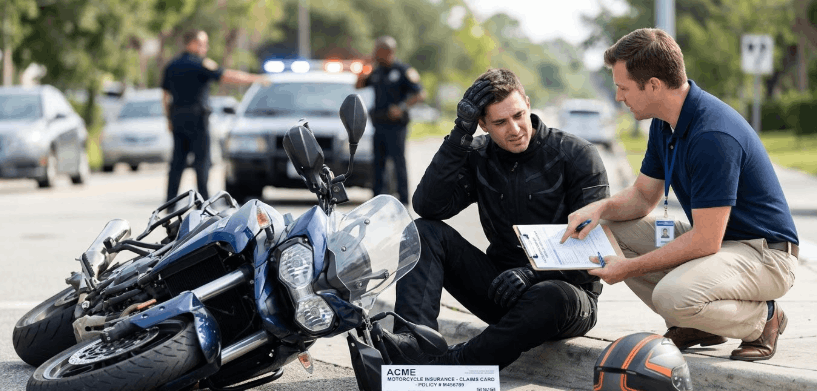

An insurance professional’s honest breakdown of what your motorcycle policy actually covers after a crash, what it doesn’t, and the coverage decisions that separate a $7,500 payout from a $200,000 settlement.
By Marcus Delgado, Licensed Insurance Advisor & Motorcycle Safety Analyst | 12+ years advising riders on personal injury protection and accident claims | Updated March 2026
Page Contents
Key Takeaways
- Motorcyclists are 28 times more likely to die in a crash per mile traveled than car occupants, according to the National Highway Traffic Safety Administration (NHTSA).
- The average motorcycle accident settlement is $73,700, but initial insurer offers typically come in 15 to 30% below what they’ll actually pay.
- “Full coverage” does not exist as a real policy term. It’s marketing language that obscures serious gaps, especially around guest passenger liability and custom parts.
- Uninsured motorist coverage costs roughly $5 to $10 per month and is the single most undervalued add-on for riders.
- The first 48 hours after your crash will determine the trajectory of your entire insurance claim.
Here’s a number that should bother you: 6,335 motorcyclists were killed in traffic crashes in 2023. That’s 15 percent of all traffic fatalities in the United States, despite motorcycles making up only about 3 percent of registered vehicles. Another 82,564 riders were injured that same year.
Those aren’t just statistics. Those are people who went for a ride on a Tuesday afternoon and didn’t come home the same way they left. And for the ones who survived, many discovered something brutal in the weeks that followed: their motorcycle accident insurance didn’t cover what they assumed it would.
I’ve spent over 12 years reviewing motorcycle insurance policies and advising riders through the claims process. And I’ll be direct with you. Most riders are underinsured. Not because they’re careless, but because the insurance industry has done a spectacular job making motorcycle coverage feel simple when it’s anything but. The gap between what riders think they’re covered for and what their policy actually pays out after an accident is, in my experience, the single biggest financial risk in motorcycling today.
Let’s fix that.
Motorcycle accident insurance is a category of financial protection designed to cover the costs associated with injuries, property damage, and liability that result from a motorcycle crash. It works through a combination of mandatory and optional coverage types, including liability, collision, comprehensive, medical payments, and uninsured/underinsured motorist protection. Unlike standard auto insurance, motorcycle accident coverage requires riders to address unique risks such as the absence of structural protection, higher injury severity rates, and optional guest passenger liability. As of 2023, the NHTSA reports that motorcyclists were approximately 28 times more likely to die in a crash per vehicle mile traveled than passenger car occupants and about 5 times more likely to be injured.

Why “Full Coverage” Is a Myth That Costs Riders Thousands
Let’s start by killing the phrase that does more damage to motorcycle riders than potholes and distracted drivers combined: “full coverage.”
It doesn’t mean what you think it means. There is no insurance product called “full coverage.” When your agent uses that term, they’re typically referring to liability plus collision plus comprehensive. Sounds thorough, right? It’s not. That combination still leaves gaping holes in your protection after a motorcycle accident, and those holes tend to become visible only when you’re in a hospital bed reviewing your policy’s declarations page.
Consider what standard “full coverage” motorcycle insurance typically leaves out. Guest passenger liability, which covers injuries to the person riding behind you, is a separate add-on in many states. Custom parts and equipment coverage, which protects the $3,000 exhaust system and aftermarket fairings you installed, is usually capped at just $1,000 under base policies. And here’s the one that catches the most people off guard: in no-fault states like Florida and Michigan, Personal Injury Protection (PIP) is mandatory for cars but often excluded from motorcycle policies entirely.
According to data from the Bureau of Transportation Statistics, motorcycle fatalities have increased 38 percent over the last decade, while the injury rate climbed 19 percent from 2022 to 2023 alone. The physics haven’t changed. A car gives you a steel cage, airbags, and four points of contact with the road. A motorcycle gives you none of those things. And yet, many riders carry coverage designed with car-accident math in mind.
That disconnect costs people real money. I worked with a rider in 2024 who carried what his agent called “the works” on a Harley-Davidson Street Glide. After a left-turn collision at an intersection (the most common type of fatal motorcycle crash, per the NHTSA), he discovered his policy didn’t cover his passenger’s $47,000 in medical bills because guest passenger liability wasn’t included. He thought he was covered. He wasn’t even close.
The lesson? Pull out your declarations page today. Not tomorrow. Today. Look for these specific line items: guest passenger liability, custom parts and equipment limits, uninsured/underinsured motorist bodily injury, and medical payments or PIP coverage. If any of those are missing or set at state minimums, you’ve got work to do.
How to File a Motorcycle Accident Insurance Claim (The 48-Hour Framework)
The first two days after a motorcycle crash are, without exaggeration, the most consequential 48 hours of your entire claim. I’ve watched riders lose five-figure settlements because of mistakes made in the fog of adrenaline and shock. So let me walk you through exactly what to do, step by step, using the framework I share with every client.
1 Secure the Scene and Get the Police Report
Call 911, even if you think you’re fine. That official police report becomes the backbone of your insurance claim. Some states won’t even let you file without one for accidents above a certain dollar threshold. Beyond that, memories change once insurers get involved. The officer’s written account of the scene, the other driver’s statements, and any cited violations create a record that’s extremely difficult for an insurance adjuster to dispute later.
While you’re waiting for officers, use your phone’s voice recorder to capture your immediate recollection of what happened. Details evaporate fast, and that recording becomes critical when you’re filling out claim forms two weeks later.
2 Document Like Your Financial Future Depends on It (Because It Does)
Photograph everything: your bike, the other vehicle, road conditions, traffic signals, skid marks, debris patterns, and every visible injury, no matter how minor it looks. Get wide-angle context shots and close-ups. If there are witnesses, collect their contact information. This documentation creates leverage during negotiation that no amount of verbal testimony can replace.
Here’s something most articles won’t tell you: do not apologize at the scene. “I’m sorry” feels polite, but insurance adjusters can interpret it as an admission of liability. Keep your statements factual. Date, time, location. That’s it.
3 Notify Your Insurer (But Watch What You Say)
Most motorcycle insurance policies require you to report an accident within 24 to 72 hours. When you call, stick to the basics: when it happened, where it happened, and who was involved. Do not speculate about your injuries or accept any fault. And do not agree to a recorded statement without speaking to an attorney first. Insurers are required to handle claims in good faith, but they also have financial incentives to limit payouts. Those two realities exist simultaneously.
4 Track Every Dollar and Every Symptom
Start a dedicated file for medical bills, prescription receipts, physical therapy invoices, towing costs, rental transportation, and lost wages documentation. Keep a daily pain journal documenting how your injuries affect your routine. That journal is powerful. Insurance companies can’t effectively dispute your own contemporaneous records of how the accident changed your daily life.
Many riders don’t realize that injuries from motorcycle crashes often take days or even weeks to fully surface. Soft tissue damage, internal bruising, and concussion symptoms can be delayed. This is why you should never accept a quick settlement offer before you’ve reached maximum medical improvement. The initial offer is almost never the final number.
Motorcycle Insurance vs. Car Insurance: The Coverage Differences That Catch Riders Off Guard
If you’ve had car insurance for years and recently bought a motorcycle, you’re probably making a dangerous assumption: that the coverage works the same way. It doesn’t. And the differences aren’t minor.
| Coverage Type | Car Insurance | Motorcycle Insurance |
|---|---|---|
| Guest Passenger Liability | Typically included under standard liability | Often a separate, optional add-on |
| Personal Injury Protection (PIP) | Mandatory in no-fault states | Frequently excluded from motorcycle policies |
| Custom Parts Coverage | Covers factory specs; aftermarket limited | Base policies cap at roughly $1,000 for custom parts |
| Collision Coverage | Covers vehicle based on ACV | Covers bike based on ACV; custom mods may not be included |
| Average Annual Premium | ~$1,700 (full coverage) | ~$571 (full coverage) or ~$154 (liability only) |
| Fatality Risk Per Mile | Baseline | 28x higher than passenger cars |
The premium gap is striking. Motorcycle insurance averages roughly $571 per year for what insurers call full coverage and about $154 for minimum liability, according to 2025 industry data. That’s significantly less than the national average for car insurance. But here’s the kicker: the lower premium doesn’t mean you’re getting equivalent protection. You’re getting less protection for a vehicle that’s statistically 28 times more dangerous per mile traveled.
Why are motorcycle premiums cheaper? Partly because bikes cost less to repair or replace than cars, and partly because the industry knows that injury claims, not property claims, are where the real costs land. And many of those injury costs get pushed onto the rider through coverage gaps, medical debt, or settlements that don’t reflect the full scope of the damage.
What About Uninsured Motorist Coverage for Motorcycles: Is It Worth It?
Short answer: it’s the best insurance money you’ll ever spend.
According to the Insurance Research Council, approximately 12.6 percent of U.S. drivers are uninsured. That’s roughly one in eight cars on the road carrying zero coverage. In some states, like Mississippi, the rate climbs above 29 percent. Now factor in that the National Transportation Safety Board has found that in 64 percent of multi-vehicle motorcycle crashes, the other driver caused the accident. If that other driver has no insurance, their lack of coverage becomes your financial problem unless you carry uninsured/underinsured motorist (UM/UIM) protection.
The cost? Roughly $5 to $10 per month for $100,000/$300,000 in coverage. For context, that’s less than what most people spend on coffee in a week. Personal injury attorneys I’ve worked with, including Barry P. Goldberg, a Los Angeles trial lawyer with over 35 years handling uninsured motorist cases, consistently recommend matching your UM/UIM limits to your liability limits at minimum. If you can afford $250,000/$500,000, that’s even better, particularly because many umbrella insurance policies require $250,000 in underlying UM/UIM coverage before they’ll extend additional protection.
I’ll put it this way. If you ride regularly and you don’t carry uninsured motorist coverage, you’re gambling that every single driver you share the road with made responsible insurance decisions. Based on the data, that’s a bet you’ll lose roughly one out of every eight times.
Real Settlement Numbers, Denied Claims, and When to Hire an Attorney
Let’s talk money, because this is where the rubber meets the road (pun intended, though the subject is serious).
Settlement data compiled from 100 motorcycle accident cases between 2021 and 2024 shows the following range: a minimum settlement of $7,500, a maximum of $375,000, and an average of $73,700. The median sits at $49,000, which tells you that a handful of high-value cases pull that average up. For most riders, a settlement in the $25,000 to $75,000 range is the realistic outcome for moderate bodily injury claims.
But those numbers assume your claim doesn’t get denied. And denial is more common than people realize.
What to Do If Your Insurance Company Denies Your Motorcycle Accident Claim
Claim denials happen for a range of reasons: disputed liability, lapsed coverage, missed reporting deadlines, or the insurer arguing that your injuries were pre-existing. If it happens to you, don’t panic, but don’t accept it passively either.
First, request the denial in writing with the specific policy language the insurer is citing. Second, review that language against your actual policy. I’ve seen denials overturned simply because the adjuster cited the wrong exclusion clause. Third, file a formal appeal with supporting documentation: updated medical records, witness affidavits, the police report, and any additional evidence you’ve gathered. Fourth, if the appeal fails, file a complaint with your state’s Department of Insurance. Insurers are legally required to handle claims in good faith, and regulatory pressure from a DOI complaint can change the calculus quickly.
Should you hire an attorney? The honest answer is: it depends. For claims under $10,000 with clear liability, you can likely handle it yourself. For anything involving disputed fault, serious injuries, or a settlement offer that feels low, an experienced motorcycle accident attorney almost always pays for themselves. Most work on contingency (typically 33 percent of the settlement), meaning you pay nothing upfront. And here’s a data point worth considering: initial insurance offers typically come in 15 to 30 percent below what the company is actually willing to pay. An attorney who pushes that number up by even 20 percent more than covers their fee.
One more thing that doesn’t get discussed enough in these articles: anti-motorcyclist bias is real in claims handling. Adjusters, juries, and even some judges carry unconscious assumptions about riders being reckless. A good motorcycle accident attorney knows how to counter that bias with evidence, expert testimony, and accident reconstruction data. That’s not something a general personal injury lawyer always understands.
Best Motorcycle Insurance for High-Risk Riders and Riders with Previous Accidents
If you’ve had a previous accident or carry points on your license, you already know the sting of being labeled “high risk.” Your premiums jump, your options shrink, and some carriers won’t touch you at all. But you still need coverage that will actually protect you if (when) something happens again.
Based on 2026 industry data and rider feedback, Progressive stands out for high-risk riders specifically because they offer accident forgiveness on claims under $500, meaning your rates won’t spike after a minor incident. Markel, a specialty motorcycle insurer, offers diminishing deductible programs that reward claim-free periods. Dairyland (owned by Sentry Insurance) is built for riders who’ve been turned away elsewhere, offering bare-bones pricing that still meets state requirements.
Now, you might be wondering: can I actually lower my premiums after an at-fault accident? Yes, but it takes time and strategy. Completing a Motorcycle Safety Foundation (MSF) course can reduce premiums by 5 to 15 percent with most carriers. Bundling your motorcycle and auto policies triggers multi-vehicle discounts. Installing anti-theft devices and maintaining a clean record for 12 or more months will steadily bring your rates back down.
But here’s my contrarian take, and it’s one I stand behind after reviewing hundreds of policies: don’t let premium cost be the primary factor in choosing your motorcycle insurer. The cheapest policy is often the most expensive one after an accident. Some large auto insurers outsource their motorcycle claims to third-party adjusters who don’t understand the difference between cosmetic fairing damage and structural frame compromise. That knowledge gap costs riders thousands in undervalued repair estimates. Before you sign, check online reviews specifically for motorcycle claims handling, not just general customer satisfaction scores.
Frequently Asked Questions About Motorcycle Accident Insurance
How long do I have to file a motorcycle accident insurance claim?
Most policies require notification within 24 to 72 hours of the accident. However, the statute of limitations for filing a personal injury lawsuit varies by state, ranging from one to six years. File your insurance claim immediately and consult an attorney before the legal deadline approaches.
Does motorcycle insurance cover me if I was lane splitting?
It depends on state law. Lane splitting is legal in California under specific conditions. If you were lane splitting legally at the time of the crash, your insurer cannot retroactively deny medically necessary treatment solely because of how you were riding. However, in states where lane splitting is illegal, comparative fault rules may reduce your payout.
What happens when the insurance company totals my motorcycle?
The insurer pays out the actual cash value (ACV) of your bike at the time of the accident, which may be significantly less than what you owe on a loan. This is where GAP insurance (Guaranteed Asset Protection) becomes critical. GAP coverage pays the difference between the ACV payout and your remaining loan balance, preventing you from owing money on a bike you can’t ride.
Can I handle my motorcycle accident insurance claim without a lawyer?
For straightforward claims with clear liability and minor injuries, yes. Report the crash, document everything, submit your demand, and negotiate. For claims involving disputed fault, serious bodily injury, denied coverage, or settlements above $15,000, hiring an attorney typically results in a higher net payout even after legal fees.
As of March 2026, the information in this article reflects current NHTSA data, industry settlement research, and state insurance regulations. Laws and coverage requirements vary by state and change frequently. Always verify your specific policy terms with your insurer or a licensed insurance professional.