

Here’s a number that stopped me mid-coffee last month. 92% of university students now use AI tools for their coursework. That’s up from 66% just one year earlier, according to a 2025 global survey cited by the Digital Education Council. Not a gentle uptick. A tidal wave.
I’ve spent the past decade consulting on technology in education for school districts and universities across India and the U.S., and I’ve never seen a shift this fast. Teachers are scrambling to write AI policies. Parents are confused. Students? They’ve already moved on to the next tool.
So what’s actually working in classrooms right now, and what’s quietly making things worse? I’ll give you the honest pros and cons of technology in education based on 2026 data, real case studies, and a few hard lessons I’ve picked up along the way. No cheerleading. No doom-scrolling. Just what the evidence says.
Page Contents
What Does Technology in Education Actually Mean?
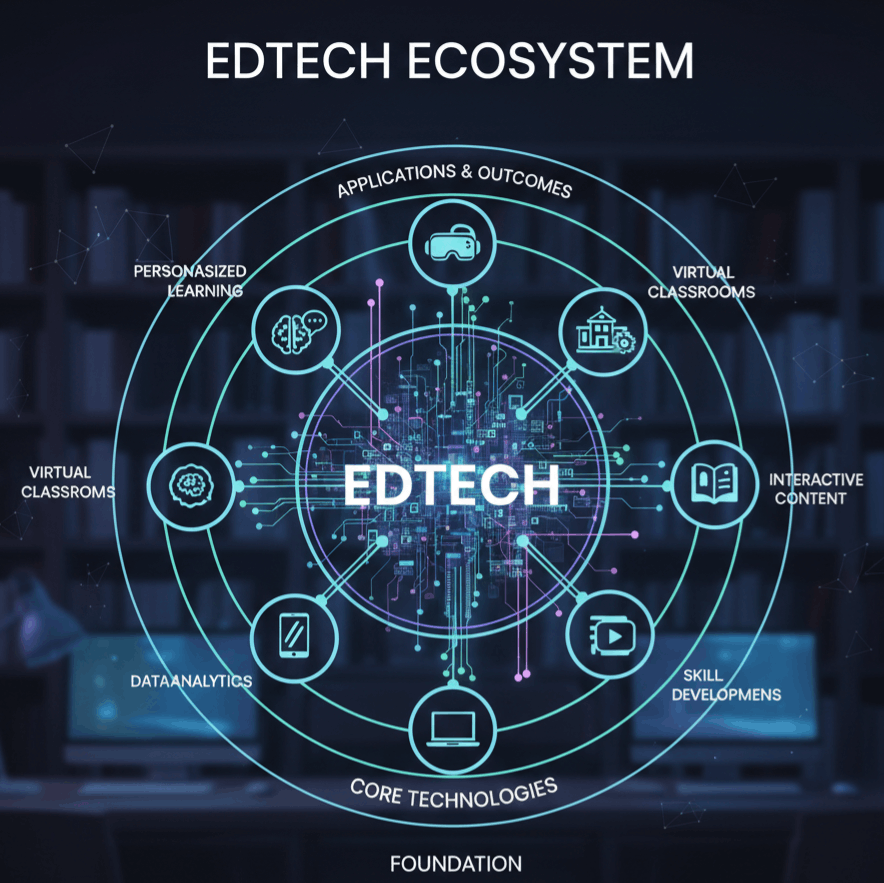
Technology in education refers to the use of digital tools, platforms, and devices to support teaching and learning. This includes hardware like laptops and tablets, software like learning management systems (Canvas, Google Classroom), AI-powered tutors (Khan Academy’s Khanmigo, Duolingo Max), communication platforms, and assessment tools. As of 2026, the global AI-in-education market alone is valued at $9.58 billion, according to Precedence Research, and is projected to reach $136.79 billion by 2035.
Why the Classroom Changed More in 2025 Than in the Previous Decade
The impact of technology on students used to be a slow-burn conversation. Not anymore. Between January and October 2025, generative AI usage among university students jumped from 53% to 88% for assessments alone, according to a HEPI survey. That’s not a trend. That’s a before-and-after moment for education.
A RAND Corporation study published in September 2025 confirmed what many teachers already felt: 54% of students and 53% of ELA, math, and science teachers reported using AI for school, with increases of more than 15 percentage points in just one to two years. And yet, as the same RAND report noted, professional development for teachers and formal policies on AI use are lagging far behind adoption.
This gap is the story of technology in education in 2026. The tools are racing ahead. The guidance hasn’t caught up.
I saw this firsthand in November 2025, helping a mid-size school district in Karnataka set up AI usage guidelines. The policy committee had 11 people. Only two had actually used ChatGPT. The students they were writing the policy for? Every single one I interviewed was using at least two AI tools daily. Sound familiar?
Meanwhile, a White House Executive Order signed in April 2025 titled “Advancing Artificial Intelligence Education for American Youth” pushed to unify AI education from K-12 through postsecondary. The U.S. Department of Education released guidance supporting schools in using existing federal grants for AI integration, including high-impact tutoring and automating administrative tasks. The direction is clear. The execution is messy.
EdTech Tools for Students That Are Actually Making a Difference
Not all EdTech tools for students deserve the hype. Some do. Here are the platforms producing measurable outcomes in 2026 classrooms, not just engagement metrics on a dashboard.
Khan Academy’s Khanmigo
This is the one I keep recommending. Khan Academy’s AI-powered tutor went from 40,000 K-12 users in 2023-24 to over 700,000 in 2024-25, with projections exceeding one million for the 2025-26 school year. Khanmigo uses a Socratic method approach, asking guiding questions rather than handing out answers, which makes it fundamentally different from students just pasting homework into ChatGPT. In January 2026, Google announced a partnership with Khan Academy to build further AI learning tools, signaling where the industry’s biggest players see the future heading.
One Oklahoma high school teacher summed it up on the Khan Academy blog: “How did teachers in the past ever function without it?”
Google Classroom and Microsoft Teams for Education
These aren’t flashy, but they’re foundational. Google Classroom remains the dominant LMS in K-12, and Microsoft’s Copilot integration into Teams for Education is adding AI-powered lesson planning, meeting summaries, and content generation. According to the Digital Education Council, ChatGPT (66%), Grammarly (25%), and Microsoft Copilot (25%) are the most-used AI tools among students globally.
Adaptive Learning Platforms
Tools like DreamBox Learning (math), Duolingo (languages), and Squirrel AI (China’s $2 billion adaptive learning startup) adjust difficulty in real time based on student performance. A study cited by Engageli found that students using AI-powered personalized learning scored 54% higher on tests compared to traditional instruction. That’s a number worth pausing on.
The Honest Pros and Cons of Technology in Education
Here’s where most articles fall apart. They either cheerlead for EdTech or catastrophize about screen time. Reality is messier. Let me give you five genuine benefits of technology in education and five challenges of technology in the classroom that the data actually supports.
5 Real Benefits of Technology in Education
1. Personalized learning at scale. AI tutors like Khanmigo adapt to individual student pace and skill gaps. At Macquarie University, introducing AI chatbot tools led to a 10% increase in student exam results by March 2025. When I worked with a district deploying adaptive math software in 2024, struggling 6th graders gained an average of 1.3 grade levels in reading comprehension over eight months. That’s the kind of outcome that justifies the investment.
2. Access beyond the classroom walls. A student in rural Namibia can now watch the same MIT OpenCourseWare lecture as someone at a Boston prep school. UNESCO’s International Day of Digital Learning 2025 highlighted how even SMS-based learning programs in Kenya are reaching students with limited internet access. The playing field isn’t level yet, but it’s less tilted than it was five years ago.
3. Instant feedback loops. Waiting two weeks for a graded essay teaches patience, not writing. AI writing coaches like Khan Academy’s Writing Coach and Grammarly give students immediate, actionable feedback on structure, grammar, and argument quality. Teachers I’ve worked with say this frees them to focus on higher-order thinking during class time instead of correcting comma splices.
4. Teacher workload reduction. According to Forbes, 38% of teachers now use AI to generate lesson plans and 37% use it for creating classroom materials. A high school English teacher in Indiana reported that rubric creation, which normally took an hour, now takes 15 minutes with Khanmigo. Multiply that across a school year and you’re giving teachers hundreds of hours back.
5. Engagement through interactivity. Over 97% of students say they’re more likely to engage with courses that incorporate AR and VR, according to industry surveys. Gamified learning platforms and interactive simulations keep students invested in ways a textbook page simply can’t match. (Though let me be clear: engagement without learning outcomes is just entertainment.)
5 Challenges of Technology in the Classroom
1. The academic integrity crisis is real. 72% of educators report plagiarism and cheating as their primary concern with AI, according to a global survey. And 88% of students now use generative AI for assessments. That’s not a fringe problem. It’s a structural one. When I ask teachers what keeps them up at night about technology in education, this is always the first answer.
2. The digital divide hasn’t closed. UNESCO’s 2023 Global Education Monitoring Report warned that the most disadvantaged students are typically denied the opportunity to benefit from technology. That hasn’t changed. In 2025, 244 million children worldwide still weren’t in school. Giving a Chromebook to a student who doesn’t have reliable electricity or Wi-Fi at home isn’t a solution. It’s a gesture. (Trust me, I’ve watched well-meaning districts learn this the hard way.)
3. Screen time and mental health. The research is mixed here, and I want to be honest about that. Some studies show moderate tech use correlates with better academic outcomes. Others flag increased anxiety, disrupted sleep, and shortened attention spans, particularly among younger students. UNESCO’s own position is that technology should “support, but never supplant, the human connection on which teaching and learning are based.” That feels right to me.
4. Teacher training isn’t keeping pace. Only 42% of university students in 2025 thought their institution’s staff were well-equipped to work with AI tools, up from just 18% in 2024. That’s improvement, but it still means the majority of students feel their teachers are behind. The RAND study found that 74% of school districts aim to train teachers in AI by 2025, but planning and doing are very different things.
5. Distraction is baked into the devices. You can’t hand a 14-year-old a device that accesses TikTok, YouTube, and Instagram and then be shocked when they get distracted during a biology lecture. Content filtering helps, but it doesn’t solve the fundamental tension. The same device that enables learning also enables everything that competes with learning.
Pros vs. Cons of Technology in Education at a Glance:
| Benefits of Technology in Education | Challenges of Technology in the Classroom |
| AI personalization boosts test scores by up to 54% | 72% of educators cite cheating/plagiarism as top concern |
| Global access via platforms like Khan Academy, MIT OCW | 244M children still out of school; digital divide persists |
| Instant feedback cuts teacher grading workload by 75% | Mixed evidence on screen time and mental health |
| 38% of teachers use AI for lesson planning | 58% of students feel teachers lack AI readiness |
| 97% of students prefer AR/VR-enhanced courses | Same devices that enable learning also enable distraction |
What Happens When a School Gets It Right: A Real Case Study
Khan Academy’s reimagined platform, currently piloting with several U.S. districts ahead of a full rollout in the 2026 school year, offers a window into what thoughtful EdTech implementation looks like. The platform embeds Khanmigo directly into the learning experience rather than bolting it on as an afterthought. Students get AI coaching that encourages persistence, not shortcuts. Teachers receive actionable insights delivered to them instead of buried in dashboards.
Sal Khan, founder and CEO of Khan Academy, described the philosophy in an October 2025 blog post: the goal is using technology “in conjunction with great education leaders, making sure they’re in the loop to engage students and improve their academic outcomes.” That “in conjunction” matters. Not instead of. Not on top of. Alongside.
At UNESCO’s Digital Learning Week in September 2025, Assistant Director-General for Education Stefania Giannini struck a similar note, emphasizing that “the future of education will be shaped by the policy choices that we make about education investment, about pedagogy, about governance and about the ethical principles we uphold.”
Here’s my contrarian take: the biggest risk to technology in education isn’t that the tools are bad. It’s that schools adopt tools without changing anything else. You can’t drop Khanmigo into a classroom that still runs on 45-minute lecture blocks and expect transformation. The tool is only as good as the teaching model it plugs into.
Frequently Asked Questions
Is technology in education actually improving student outcomes?
In many cases, yes. Students using AI-powered adaptive learning platforms scored 54% higher on tests compared to traditional instruction, according to research cited by Engageli. Macquarie University saw a 10% exam score increase after introducing AI chatbot tools. However, results depend heavily on implementation, teacher training, and whether the technology supports or replaces active learning.
What percentage of students use AI for schoolwork in 2026?
As of early 2026, approximately 92% of university students have used AI tools for coursework, up from 66% in 2024. Among K-12 students, 54% reported using AI for school in 2025, according to the RAND Corporation. ChatGPT remains the most popular tool, used by 66% of students globally.
What are the biggest risks of technology in the classroom?
Academic integrity tops the list, with 72% of educators citing cheating and plagiarism as their primary AI concern. Other significant risks include the persistent digital divide (244 million children still out of school), uneven teacher preparedness, student data privacy, and the mental health effects of increased screen time.
What are the best free EdTech tools for students in 2026?
Khan Academy (with Khanmigo’s free AI teaching assistant), Google Classroom, Duolingo, Grammarly’s free tier, and MIT OpenCourseWare are among the strongest free options. Khan Academy’s Khanmigo became free for all teachers in 2025 and provides AI-powered lesson planning, rubric creation, and student tutoring at no cost.
How are schools creating AI policies for students?
Most are starting from scratch. Only 38% of teachers formally allow AI use in their classrooms. The RAND Corporation found that district-level policies are lagging well behind student adoption. Best practice involves creating clear guidelines that distinguish between AI-assisted learning (acceptable) and AI-completed work (not), while training both teachers and students on responsible use.
How much is the AI in education market worth?
The global AI in education market reached $7.05 billion in 2025 and is projected to hit $9.58 billion in 2026, according to Precedence Research. Long-term projections estimate the market will grow to $136.79 billion by 2035, driven by adaptive learning platforms, AI tutoring, and automated administrative tools.
Three Things That Actually Matter Going Forward
After a decade of consulting on technology in education, here’s what I’d want every teacher, administrator, and parent to take away:
First: match the tool to the teaching goal, not the other way around. Don’t adopt Khanmigo because it’s exciting. Adopt it because your 4th graders need differentiated math practice and your teachers need their Tuesday afternoons back. Start with the problem.
Second: invest in teacher training before you invest in hardware. A $500 Chromebook in the hands of a teacher who hasn’t been trained is a $500 distraction device. The 74% of districts planning AI training need to actually follow through.
Third: involve students in the conversation. They’re not passive recipients of EdTech decisions. They’re already using tools that most school boards haven’t heard of yet. Build policy with them, not just for them.
The pros and cons of technology in education aren’t going to resolve into a clean answer. The technology will keep accelerating. What matters is whether schools, teachers, and families make deliberate choices about how to use it, rather than just letting it happen to them.
What’s your experience been? Whether you’re a teacher figuring out AI policies or a parent watching your kid use ChatGPT for homework, share your story in the comments. The best ideas I’ve seen come from people in the trenches, not from consultants like me.