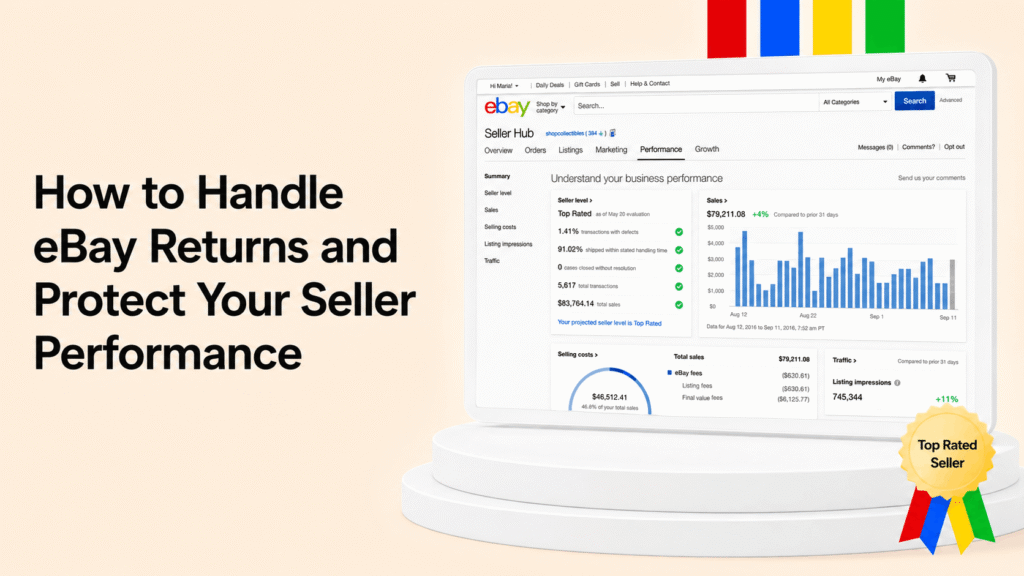

A product return request can feel like a strike against your seller account, but returns are a normal part of selling on eBay, and they don’t decide your standing on their own.
What shapes your eBay seller rating is your eBay returns management: how quickly you respond, which resolution you choose, and whether repeated “item not as described” claims start to build a pattern over time.
When handled right, returns remain a routine cost of selling on eBay. Managed poorly, they can escalate into unresolved cases, transaction defects, or seller performance issues. Every one of those outcomes is within your control, and it starts with knowing what your seller rating actually measures.
Page Contents
What “Seller Rating” Really Means on eBay?
“Seller rating” may seem like one metric, but eBay measures your reputation as a seller in three separate ways, and a return affects each one differently. Knowing which one is at stake tells you whether a return is a routine event or a real risk to your account.
Your Feedback Score and Star Rating
This is the percentage of positive ratings shown under your username, along with a star icon and the total number of buyers who have rated you.
It comes entirely from buyer feedback. A return by itself doesn’t change it, but a buyer who is unhappy with how the return was handled can leave negative feedback, and that comment stays on your profile.
Your Seller Level (Top Rated, Above Standard, or Below Standard)
eBay reviews your performance on a fixed schedule and assigns one of three levels. The “Seller Level” comes from measures such as transaction defect rate and the number of cases closed without seller resolution, rather than the number of returns you receive. Dropping to “Below Standard” can raise your final value fees, lower search visibility, and lead to account restrictions, such as limits on how many items you’re allowed to list.
Your Service Metrics
The third measure is your service metrics, which track how often buyers report a problem with products they received.
For eBay returns, the metric that matters is your Item Not as Described (INAD) rate, formerly known as the SNAD rate. It sits alongside your “Item not received” rate and counts returns where a buyer says the item didn’t match the listing.
Unlike your feedback score and seller level, this metric is tied directly to the return reason the buyer selects, which makes it the first place where poorly handled returns become visible. eBay benchmarks your volume of “Item not as described” requests against peer sellers in your category, ensuring your standing is judged relative to similar sellers rather than an absolute number.
Two thresholds keep the occasional return from affecting you. Your performance is unaffected as long as either holds true:
- Your INAD rate stays under 1% of transactions in a category, or
- You have received fewer than ten INAD requests from separate buyers.
A pattern of “Item not as described” returns, by contrast, can signal problems with your listings, product condition, photos, packaging, or quality control. If your INAD rate becomes “Very High” compared with similar sellers, eBay does not downgrade your seller level. Instead, it charges an additional 4% final value fee on sales in that specific product category.
When Do Product Returns Affect Your eBay Seller Rating?
Two buyers can return the same item and leave you in very different positions, depending on the reason each one selects. Most returns have no effect on your eBay seller rating. The ones that cause damage share specific traits; once you recognize them, you know which cases need careful handling.
Your eBay product returns fall into two broad groups:
- A buyer’s remorse return occurs when the buyer changes their mind, orders the wrong size, or no longer wants the item. These don’t affect your service metrics, regardless of your eBay return policy.
- The second group is an “Item not as described” return, often called INAD by sellers. In this return type, the buyer states that the item arrived damaged, defective, incorrect, or different from the listing.
The reason the buyer selects when opening the return request determines which group the return falls into. That is why the selected return reason can matter as much as the return itself.
How to Handle an eBay Return Request as a Seller?
Handling a return request well is the core of eBay returns management, and it comes down to three moves: responding in time, choosing the right response, and matching that resolution to the buyer’s reason.
Respond Within Three Business Days
eBay notifies you the moment a buyer files a return request, and you have three business days to act. If that window passes without a response, the buyer can ask eBay to step in.
A case escalated this way and closed without your resolution becomes a transaction defect, which counts toward your seller level. Responding on time keeps the case in your control, even when your first reply is only a request for photos or more details.
Know Your Response Options
eBay gives you several ways to resolve a return request. The right one depends on the buyer’s reason and the item’s value.
| Response | Best Used When | Seller Outcome |
| Accept the return | The buyer’s reason qualifies, or your listing offers returns | You provide a return label where required, and a refund once the item is back |
| Refund without return | Return shipping would cost more than the item is worth | The buyer keeps the item, and you issue a full refund |
| Offer a partial refund | A minor fault that the buyer is willing to keep the item for | The buyer keeps the item, and you refund part of the price |
| Send a replacement or exchange | You hold the same item in stock, and the buyer agrees | You ship a new unit instead of refunding |
| Decline the return | Buyer remorse only, and your listing states no returns | The request closes, provided the reason is genuinely remorseful |
Choose the Resolution That Limits Damage
The buyer’s stated reason sets your options. When the return is marked as INAD, you are expected to accept it and provide the prepaid return label, as declining an INAD case or letting it escalate creates a defect.
When the return is due to buyer’s remorse, your stated policy determines whether you accept it or decline it. Sound eBay returns management comes down to matching the resolution to the reason, which protects both your costs and your standing.
eBay Seller Protection to Limit Your Losses
When a return is unfair, eBay offers ways to recover your money and protect your eBay seller rating. Each measure is allotted for a specific situation.
| Scenario | Options Provided for eBay Seller Protection | What You Must Do |
| The item comes back used or damaged | Deduct up to 50% from the refund to recover the lost value | Report the buyer and refund within 2 business days; you qualify if you offer free returns
or are a top-rated seller with 30-day returns |
| A buyer files a false “not as described” claim | eBay removes the related feedback, keeps the return out of your INAD rate, and credits up to $6 of return postage (Top Rated Sellers) | Use the “Report Buyer” option inside the return request. eBay grants protection once it confirms the claim was false. |
| A buyer acts abusively, through false claims or return fraud | eBay removes its feedback, defects, and open cases against you | Report the buyer. If eBay finds the behavior abusive, it removes the negative feedback against you.
|
Note: Once eBay steps in on a return request, you lose the option to deduct. Hence, resolve it yourself before it escalates.
Setting a Return Policy That Works in Your Favor
An effective eBay return policy protects both the buyer experience and your seller account. It sets expectations before the sale, so fewer returns turn into complaints or escalated cases. It also gives you a process to follow when a return request comes in. Three settings matter most:
- Return shipping: Free returns cost you postage per case. However, it grants both “Top-Rated” and “Above Standard” sellers access to the 50% deduction tool while giving your listings a significant visibility boost in search results. Setting return shipping to “Buyer Pays” can lower your cost on each return, but it may also limit your refund deduction options, depending on your seller level.
- Return window: Offer 30-day or longer return windows. This helps you qualify for the top-rated safeguards that eBay provides. For example, it offers a “50% refund” deduction for damaged or altered products. You won’t be eligible with short return windows.
- Accepted reasons: You can switch off buyer-remorse returns, but not not-as-described ones. eBay’s Money Back Guarantee overrides a “no returns” setting whenever a buyer reports an item as damaged, faulty, or different from the listing.
Settled this way, your return policy starts working before more returns come in, deciding disputes in your favor.
Preventing eBay Product Returns at the Listing Stage
Most returns that damage your rating are the “Item Not as Described” kind, and most of those trace back to the listing, where the item promised more than it delivered. A few habits go a long way toward cutting down eBay returns:
- Be honest about the product condition so buyers know exactly what to expect.
- Show the actual item in clear, true-to-life photos rather than relying on stock images.
- State exact measurements, specifications, and compatibility, since these are the details buyers most often get wrong.
Accurate listings cut returns across an entire catalog. Handled at the listing stage, returns become an occasional cost rather than a risk to your eBay seller rating. The sellers who protect their rating are the ones whose listings match what the buyer actually receives.
In the long run, protecting your seller rating is about responding well to returns and overall effective eBay account management, including accurate listings, clear policies, careful fulfillment, and fast communication. To manage these tasks, sellers choose one of the following options:
- They develop an in-house team to handle each return request themselves. Suitable if your business has a low volume of operations.
- Or, they outsource eBay account management. It helps keep response times, service metrics, and return policies consistent. Suitable for eBay sellers with growing operations.
Either approach can protect your seller rating, as long as returns are handled with a clear process rather than left to chance.
Author Bio- Ravi Kant is the Vice President of the eCommerce and Photo Editing Division at SunTec India. With over two decades of global experience, he spearheads large-scale digital commerce initiatives that drive operational excellence and measurable ROI for global businesses. His expertise spans eCommerce strategy, digital transformation, and data-driven performance optimization.