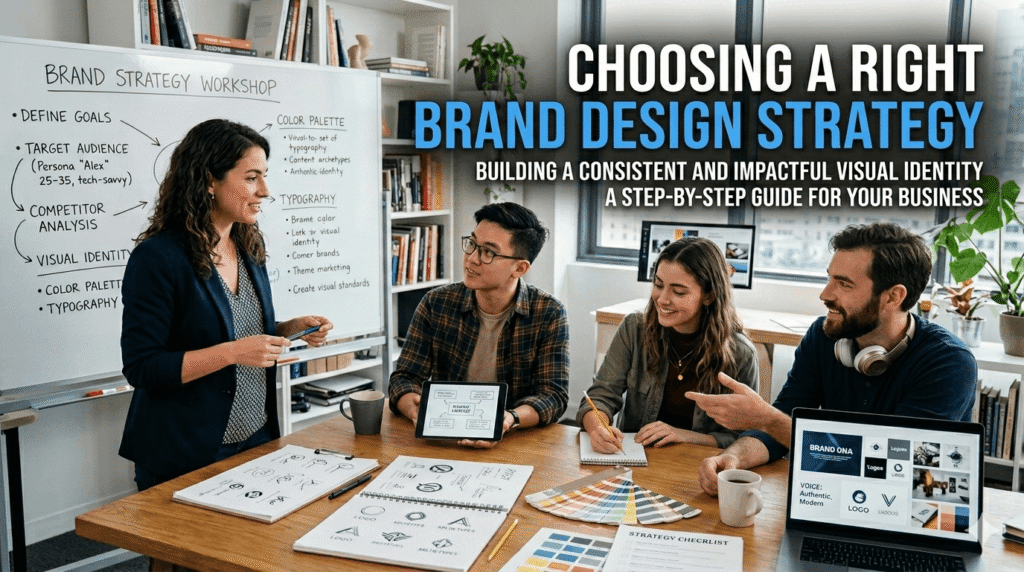

By a brand strategist with 12+ years helping startups and SMBs build identities that actually convert.
Here’s something that keeps tripping up founders: 77% of consumers buy products based on the brand name, not the product name itself. Let that sink in for a second.
You could have the best offering in your market—better features, lower price, faster delivery—and still lose to a competitor who simply looks and sounds more trustworthy. I’ve watched it happen to clients who poured their entire budget into product development and left brand design strategy as an afterthought. And honestly? I almost made the same mistake early in my career.
Choosing the right brand design strategy isn’t about picking pretty colors or a trendy logo font. It’s about making a series of deliberate decisions—about your visuals, your voice, your values—that make people feel something specific when they encounter your business. In this guide, I’ll walk you through how to actually choose a strategy that fits your business, your audience, and your budget. No fluff, no generic advice.
Page Contents
What Is a Brand Design Strategy, Really?
A brand design strategy is a structured plan that defines how a business visually and emotionally communicates its identity across every customer touchpoint. It includes your logo, color palette, typography, imagery style, brand voice, and messaging framework—all working together to create a consistent, recognizable presence. Unlike a one-off logo design, a brand design strategy connects your visual identity to your business goals, target audience, and market positioning so that every piece of content, packaging, or social media post reinforces who you are.
Why Most Small Businesses Get Brand Design Wrong

Most small business owners start branding backwards. They jump straight to a logo—maybe through a $50 freelance gig or a quick logo generator—and call it done.
But a logo without strategy behind it is just decoration.
According to the 2025 Edelman Trust Barometer Special Report on Brand Trust, 80% of people now trust the brands they use more than traditional institutions like government, media, and NGOs. That’s a staggering number. Trust isn’t built by a symbol in your header—it’s built through the consistent experience your brand creates at every single touchpoint.
And here’s the kicker: research shows that consistent brand presentation across all platforms can increase revenue by up to 23%. Meanwhile, fewer than 10% of B2B companies say they maintain fully consistent branding. That gap represents a massive opportunity—especially for smaller businesses willing to do the strategic work upfront.
Three to five years ago, you could get away with a decent logo and a Canva template. Not anymore. Consumers in 2026 expect a unified brand experience whether they’re scrolling your Instagram, visiting your website, or opening your product packaging. Miss that expectation, and you’re sending a signal that something’s off—even if your product is solid.
How to Choose the Right Brand Design Strategy for Your Business
This is the part most articles skip. They’ll tell you “define your mission and values” and leave it there. But choosing a brand design strategy isn’t a one-size-fits-all exercise. It depends on your business stage, your market, and—critically—who you’re trying to reach.
Start with your audience, not your aesthetics. I’ve seen founders spend weeks debating serif vs. sans-serif before they’ve even defined their ideal customer persona. That’s like picking a suit before you know where you’re going. Your brand design decisions—every color, every font weight, every image style—should flow from a deep understanding of who you’re speaking to and what they need to feel.
Here’s a framework I’ve used with over 40 clients that actually works:
Step 1: Audit Your Current Position
Before building anything new, document where you stand. What does your brand look like right now? How do customers describe you? If they can’t describe you at all, that’s your biggest problem. Use free tools like Google Trends or AnswerThePublic to see what language your audience uses when talking about your industry.
Step 2: Map Your Competitive Landscape
Pull up the top five competitors in your space and screenshot everything—their websites, social profiles, email templates, even their packaging. You’re not looking to copy. You’re looking for visual white space. If every competitor uses blue and corporate sans-serif fonts, there’s an opportunity to stand out with something warmer and more human.
Step 3: Define Your Brand Personality in Three Words
Not five. Not ten. Three. This constraint forces clarity. A fintech startup might land on “trusted, modern, approachable.” A premium bakery might choose “artisanal, warm, refined.” These three words become your decision filter for every design choice you make.
Step 4: Build Your Visual Identity System
This is where most people think branding starts—and it’s actually step four. Your visual identity includes your logo, color palette (primary and secondary), typography hierarchy, image/photography style, and iconography. Each element should directly connect back to your three personality words. Color alone can boost brand recognition by up to 80%, so don’t rush this decision.
Step 5: Document Everything in Brand Guidelines
If your brand identity lives only in your head, it’s going to fall apart the moment you hire a second designer or marketing contractor. Create a simple brand guideline document—even a 5-page PDF works—that covers logo usage, color codes, typography rules, voice and tone principles, and dos and don’ts. This is what separates brands that feel professional from those that feel improvised.
Why Consistent Brand Messaging Makes or Breaks Your Strategy
You can have the most gorgeous visual identity on the planet, and it won’t matter if your messaging changes tone every other Tuesday.
A Lucidpress survey found that 32% of professionals reported consistent messaging increased brand revenue by more than 20%. And according to broader research, about 90% of consumers expect a similar brand experience across all channels—your website, app, social media, and physical presence.
Sound familiar? You’ve probably experienced this yourself as a consumer. You discover a brand through a polished Instagram ad, click through to a website that looks like it was built in 2015, and immediately bounce. That disconnect isn’t just a design problem. It’s a trust problem.
The fix isn’t complicated, but it requires discipline. Your brand voice—the personality behind your words—needs to stay consistent whether you’re writing an email subject line, a product description, or a support ticket response. VistaPrint’s 2025 branding research identifies six core components that drive this consistency: brand values, target audience definition, positioning, tone of voice, personality traits, and visual uniformity.
I’ve found that the brands I work with that actually maintain messaging consistency do one thing differently: they designate a single person as the “brand guardian” who reviews all external communications. It doesn’t have to be a full-time role. It just has to be someone’s responsibility.
DIY, Freelancer, or Agency: Which Branding Path Actually Works?
Let’s be real about this. Budget constraints are real, especially for small businesses and startups. But the cheapest option isn’t always the most expensive mistake—and the priciest agency isn’t always the best choice either.
| Approach | Best For | Typical Cost | Watch Out For |
| DIY (Canva, AI tools) | Pre-revenue startups, personal brands | $0–$200 | Inconsistency, generic look |
| Freelance Designer | Seed-stage startups, small businesses | $500–$5,000 | No strategy, just visuals |
| Boutique Studio | Growth-stage businesses needing full identity | $5,000–$25,000 | Scope creep, long timelines |
| Full Agency | Funded startups, established companies rebranding | $25,000–$150,000+ | Overhead costs, over-engineering |
Here’s my honest take: if you’re a small business with under $2,000 to spend, hire a freelance designer who also understands strategy—not just someone who makes things look nice. Ask to see their brand guideline work, not just their logo portfolio. A beautiful logo without a system behind it is a car without an engine.
(Trust me, I learned this the hard way with a client who had six different logo variations floating around their own team’s presentations.)
The Trust Factor: How Brand Design Earns Customer Loyalty in 2026
This is something the branding industry doesn’t talk about enough.
The 2025 Edelman Trust Barometer found that trust now equals price and quality as a purchase consideration. Read that again. Consumers are literally weighing how much they trust your brand alongside whether your product is any good or reasonably priced.
For startups and small businesses, this is actually great news. You don’t need a massive ad budget to build trust. You need consistency, transparency, and authenticity in your brand design strategy. Here’s what that looks like in practice:
Visual consistency builds familiarity. Brands with consistent visual identity across platforms enjoy a 33% higher brand recall rate. When someone sees your Instagram post and then visits your website, the transition should feel seamless—same colors, same voice, same energy.
Transparency builds credibility. 88% of consumers say authenticity matters when deciding which brands they support. If you’re a small team, say so. If your product has limitations, acknowledge them. Honesty in branding isn’t a weakness—it’s a competitive advantage.
Emotional connection drives advocacy. 94% of consumers say they recommend brands they feel emotionally connected to. Your brand design strategy should aim to make people feel something—not just see something.
Logo Design and Branding for Startups: Getting It Right the First Time
Your logo is the most visible piece of your brand identity, but it’s also the most overemphasized. I’ve seen startups spend months iterating on a logo while ignoring their typography, color system, and messaging entirely.
That said, your logo matters. It takes roughly 10 seconds for someone to form an impression of your logo, and 65% of consumers say their first impression of a brand is based on it. So let’s talk about getting it right.
Keep it simple. The most iconic logos in history—Nike’s swoosh, Apple’s apple, Target’s bullseye—are absurdly simple. Complexity kills memorability. If your logo doesn’t work in black and white at the size of a social media avatar, go back to the drawing board.
Design for adaptability. Your logo needs to work on a business card, a billboard, a mobile screen, and potentially physical products. In 2026, with brands increasingly operating across AR, voice interfaces, and wearable tech, adaptability isn’t optional—it’s survival.
Invest wisely. Carolyn Davidson designed Nike’s swoosh for $35. Phil Knight later gave her 500 shares of Nike stock. The lesson? A great logo doesn’t require a massive budget—but it does require strategic thinking and a designer who understands your brand, not just graphic trends.
One more thing: sonic branding is emerging as a serious consideration in 2025-2026. Companies like Netflix, McDonald’s, and BMW have made audio signatures part of their brand identity. If your startup operates in digital or media spaces, think about what your brand sounds like, not just what it looks like.
What the Data Tells Us About Brand Strategy in 2026
Jackie Cooper, Global Chief Brand Officer at Edelman, put it plainly when discussing the 2025 Brand Trust report: consumers are looking to brands to be the stable thing in their life. That’s a remarkable shift from even five years ago, when brand trust was largely about product quality.
The data backs this up across multiple dimensions. VistaPrint research shows that 78% of small business owners now say visual branding plays a significant role in revenue growth. System 1’s analysis of 56 brands and over 4,000 TV ads across five years demonstrated that consistent brands score significantly higher in emotional response testing. And brands with low consistency need to spend 1.75x more on media to achieve the same growth as their consistent counterparts.
What does this mean for your brand design strategy? Stop thinking of branding as a marketing cost. It’s a compound investment. Every consistent interaction deepens recognition, builds trust, and lowers your future customer acquisition costs.
Frequently Asked Questions
How much should a small business spend on brand design strategy?
Budget depends on your stage. Pre-revenue startups can start with $200–$500 for basic brand guidelines and a logo. Growing businesses should plan for $2,000–$10,000 for a comprehensive visual identity system. What matters more than the dollar amount is choosing someone who does strategy, not just design.
Can I create a brand identity myself using AI tools?
AI tools like Canva, Looka, and Tailor Brands can generate logos and color palettes quickly. They’re useful for testing ideas early. But they can’t replace the strategic thinking behind positioning, audience alignment, and messaging consistency. Use them as a starting point, not the final product.
How often should I update my brand design strategy?
Review annually at minimum. A full rebrand is typically needed every 7–10 years, but smaller refreshes—updating photography style, adjusting color tones, refining messaging—should happen whenever your audience or market shifts significantly.
What’s the difference between brand strategy and brand identity?
Brand strategy is the plan—your positioning, target audience, messaging framework, and competitive differentiation. Brand identity is the execution—the visual and verbal elements that bring that strategy to life. You need both, and strategy always comes first.
Does consistent branding really affect revenue?
Yes. Multiple studies confirm that consistent brand presentation across platforms increases revenue by 10–23%. A Lucidpress survey found 32% of companies reported revenue increases exceeding 20% from consistent messaging alone.
What’s the biggest mistake startups make with brand design?
Treating the logo as the entire brand. Your logo is one piece of a system that includes typography, color, voice, imagery style, and messaging. Without the system, you’re building on sand.
The Bottom Line
After 12 years of building brand design strategies for businesses of all sizes, here’s what I keep coming back to:
First: strategy before design, always. If you don’t know who you’re talking to and why they should care, no amount of visual polish will save you.
Second: consistency is your compound interest. Every touchpoint that reinforces your brand identity makes the next one more powerful.
Third: trust is the new battleground. In 2026, consumers weigh trust alongside price and quality. Your brand design strategy is how you earn that trust before someone ever uses your product.
Whether you’re a solo founder sketching your first logo on a napkin or a growing team ready for a full rebrand, the principles are the same. Know your audience. Define your personality. Build a system. Stay consistent. And don’t be afraid to evolve when the market tells you to.
Start by auditing your current brand presence today. Write down those three personality words. And if what you see doesn’t match what you’ve written, that’s your signal to act.