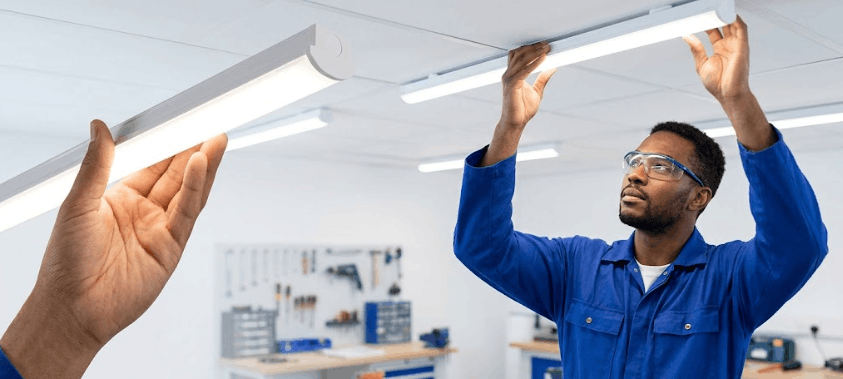

Are LED batten lights worth it? Yes. And I’m not going to make you scroll through 1,500 words before I tell you that. A quality LED batten light uses up to 65% less energy than a fluorescent tube, lasts 50,000+ hours (roughly 17 years of daily use), and pays for itself within 12 to 18 months through energy savings alone. If you’re still running fluorescents in your garage, workshop, kitchen, or office, you’re essentially paying a monthly “laziness tax” on your electricity bill.
Now let me show you exactly why, and more importantly, how to pick the right one.
Page Contents
Why LED Batten Lights Are Replacing Fluorescent Tubes Everywhere
The shift from fluorescent to LED isn’t a trend. It’s a completed revolution. According to the U.S. Department of Energy, LED technology uses at least 75% less energy than incandescent lighting and lasts up to 25 times longer. The International Energy Agency reported in March 2026 that lighting accounts for approximately 8% of global electricity demand, around 2,200 terawatt-hours annually. The global push to phase out fluorescent lighting is now backed by the Minamata Convention on Mercury, with over 150 countries committed to eliminating mercury-containing lamps.
Here’s what that means for you: fluorescent tubes are becoming harder to find, more expensive to replace, and increasingly noncompliant with building codes. California’s Title 24, for example, now requires high-efficacy lighting like LEDs in all new construction and major renovations.
But beyond regulations, the practical case is overwhelming. LED batten lights deliver instant illumination with zero warm-up time, no flickering, no buzzing, and consistent brightness throughout their entire lifespan. Anyone who’s watched a fluorescent tube flicker and dim for weeks before finally dying knows exactly why that matters.
Understanding the Numbers: Lumens, Watts, and the Ratio That Matters
This is where most buyer’s guides lose people, so I’ll keep it simple.
Lumens measure brightness. Watts measure energy consumption. The number you actually care about is lumens per watt (lm/W), which tells you how efficiently a light converts electricity into visible light.
A typical fluorescent tube produces around 50-80 lumens per watt. A modern LED batten light? The IEA reports that LEDs sold today average close to 100 lm/W, with premium products exceeding 200 lm/W. That’s not a marginal improvement. That’s a fundamentally different technology.
Let me put real numbers on this. A standard 4-foot fluorescent tube runs at about 36 watts and produces roughly 2,500 lumens. Its LED batten replacement produces the same 2,500 lumens while consuming only 18-22 watts. Over a year of 12-hour daily use, that single fixture swap saves you approximately $15-20 in electricity costs. Scale that across a commercial space with 50 fixtures, and you’re looking at $750-1,000 in annual savings.
The lifespan difference is equally dramatic. A fluorescent tube lasts about 15,000-20,000 hours before performance degrades noticeably. A quality LED batten light delivers consistent output for 50,000 hours or more, meaning fewer replacements, less maintenance labor, and zero mercury disposal concerns.
Your LED Batten Light Buying Checklist
Picking the right LED batten isn’t complicated once you know what matters. Here’s your checklist:
IP Rating (Ingress Protection): This tells you where you can safely install the light.
- IP20: Suitable for indoor environments like offices, kitchens, and living rooms. No moisture protection.
- IP65: Fully sealed against dust and water jets. Essential for bathrooms, outdoor covered areas, garages, and food processing facilities.
- IP66/IP67: Heavy-duty protection for industrial environments and fully exposed outdoor installations.
If you’re lighting a garage or workshop, don’t cheap out. Go IP65 minimum. I’ve seen too many IP20 fixtures corrode within a year in damp environments. (Yes, I made that mistake myself in my first workshop renovation.)
Color Temperature: Measured in Kelvin (K), this determines the “mood” of your light.
- Warm White (2700-3000K): Cozy, yellowish tone. Best for living rooms, bedrooms, and hospitality spaces.
- Natural White (4000-4500K): Clean, balanced light. Ideal for kitchens, offices, retail, and task lighting.
- Cool White/Daylight (5000-6500K): Bright, bluish-white. Perfect for garages, workshops, warehouses, and industrial spaces where visibility is paramount.
My recommendation? For most home applications, go with 4000K. It’s versatile, easy on the eyes during extended periods, and makes colors look accurate. For commercial and industrial spaces, 5000-6000K maximizes visibility and alertness.
Length and Output: LED battens come in standard lengths that match fluorescent tube sizes.
- 2ft (600mm): 10-20W, 1,000-2,000 lumens. Good for small utility spaces.
- 4ft (1200mm): 18-36W, 2,000-4,000 lumens. The most popular size for general-purpose lighting.
- 5ft (1500mm): 25-50W, 3,000-5,500 lumens. Common in commercial and industrial settings.
- 6ft (1800mm): 30-70W, 3,500-7,000 lumens. Heavy-duty applications.
Dimmability: Not all LED battens are dimmable. If you want this feature, specifically look for “dimmable” labeling and ensure your existing dimmer switch is LED-compatible. Older dimmer switches designed for incandescent bulbs can cause flickering or buzzing with LEDs.
CRI (Color Rendering Index): This measures how accurately colors appear under the light. A CRI of 80+ is standard for most applications. For retail displays, art studios, or anywhere color accuracy matters, look for CRI 90+.
LED Batten vs. Fluorescent Tubes: The Full Comparison
| Feature | LED Batten Light | Fluorescent Tube |
|---|---|---|
| Energy Efficiency | 100-200+ lm/W | 50-80 lm/W |
| Lifespan | 50,000+ hours | 15,000-20,000 hours |
| Warm-Up Time | Instant on | 30-60 seconds |
| Mercury Content | Zero | Contains mercury (hazardous) |
| Maintenance | Minimal | Regular tube replacements |
| Flickering | None | Common as tubes age |
| Dimmable Options | Widely available | Limited and expensive |
| Environmental Impact | RoHS compliant, recyclable | Requires special disposal |
| Annual Energy Cost (4ft, 12hr/day) | ~$10-12 | ~$18-22 |
| Color Consistency | Maintains throughout life | Degrades significantly |
The Department of Energy estimates that the average household saves about $225 annually by switching to LED lighting across their home. For businesses, the savings scale proportionally, and the reduced maintenance burden often delivers even greater value than the energy savings themselves.
Installation: Easier Than You Expect
One of the best things about modern LED batten lights is that they’re designed for straightforward installation. If you’re replacing an existing fluorescent batten fixture, you have two options:
Option 1: Direct replacement (retrofit tube). Some LED tubes are designed to work with your existing fluorescent fixture by simply swapping the tube. However, you’ll need to check whether it requires bypassing the ballast or works with your existing ballast (Type A vs. Type B tubes).
Option 2: Complete fixture swap. This is what I recommend. Remove the old fluorescent fitting entirely and install a new integrated LED batten. It’s cleaner, more reliable, and eliminates the ballast as a potential failure point. Most integrated LED battens connect directly to mains voltage and require only basic wiring knowledge.
If you’re comfortable with basic electrical work, a fixture swap takes about 15-20 minutes per unit. For anything beyond simple one-for-one replacements, or if your building has older wiring, hire a licensed electrician. The efficiency gains in your space will be well worth the installation cost.
Where LED Batten Lights Work Best
LED battens are versatile, but they truly shine (pun intended) in specific applications:
Garages and workshops: The combination of instant-on capability, high lumen output, and durability makes LED battens ideal for spaces where you need reliable, bright light on demand. An IP65-rated, 5000K batten over your workbench will change your life.
Kitchens: Slimline LED battens mounted under cabinets or flush to the ceiling provide clean, even illumination without the bulk of older fluorescent fixtures. Go with 4000K for a natural cooking environment.
Commercial offices: Energy savings compound quickly across large spaces with many fixtures. The lack of flickering and buzzing also reduces eye strain and headache complaints, which is a productivity factor many facility managers overlook.
Retail environments: High-CRI LED battens make products look their best. The consistent color temperature throughout the fixture’s life means your merchandising stays accurate for years.
Outdoor covered areas: IP65-rated battens handle rain, humidity, and temperature fluctuations without degrading. Perfect for carports, loading docks, and covered walkways.
The Smart Upgrade: What’s Coming in 2026 and Beyond
The LED industry isn’t standing still. The IEA’s March 2026 analysis identifies a “second wave” of LED deployment focused on smart integration. What does that mean for batten lights?
Smart controls integration: Newer LED battens can connect to building management systems, allowing automated dimming based on occupancy and daylight levels. This takes energy savings from 65% (over fluorescent) to 80%+ when combined with smart controls.
Tunable white technology: Some premium LED battens now offer adjustable color temperature. You can run cool white during the workday for alertness and shift to warm white in the evening. It’s particularly valuable in healthcare and education facilities where circadian rhythm matters.
Improved circularity: Manufacturers are designing fixtures with recyclable components, biodegradable plastics, and modular designs that allow LED driver replacement without discarding the entire fixture.
The LED lighting market is projected to reach $93 billion globally by 2026, according to TrendForce. Prices continue to decline while performance improves, meaning there has never been a better time to make the switch.
FAQs
Are LED batten lights worth the higher upfront cost? Absolutely. While an LED batten costs roughly 2-3 times more than a fluorescent equivalent upfront, the energy savings typically pay back that investment within 12-18 months. After that, it’s pure savings for the next 15+ years.
Can I replace a fluorescent tube with an LED without changing the fixture? In many cases, yes. Retrofit LED tubes (Type A) work with existing ballasts. However, I recommend full fixture replacement for the best long-term performance and reliability.
What IP rating do I need for a bathroom LED batten? IP65 minimum. Bathrooms have moisture and steam, and anything below IP65 risks corrosion and electrical issues over time.
Do LED battens work with dimmer switches? Only if specifically labeled as dimmable. You’ll also need an LED-compatible dimmer switch. Using an old incandescent dimmer with LEDs causes flickering and premature failure.
How much can I save by switching my office to LED batten lights? An average office with 50 fluorescent fixtures running 10 hours daily can save approximately $500-800 annually in electricity costs, plus reduced maintenance and replacement expenses.
What color temperature is best for a home garage? Go with 5000-6000K (cool white/daylight). The bright, crisp light maximizes visibility for detail work, auto repairs, and general workshop activities.
Making the Switch
After seeing hundreds of lighting upgrades across residential and commercial spaces, here’s what I’d tell anyone still hesitating:
First, the math is irrefutable. LED battens save money, period. The only question is how fast you start saving.
Second, quality matters more than price. A $15 LED batten from an unknown brand might last 15,000 hours. A $25 batten from a reputable manufacturer with proper thermal management will hit that 50,000-hour mark. Spend the extra $10.
Third, don’t overthink it. Pick your IP rating, choose your color temperature, measure your space, and order. The hardest part is getting off the couch to remove the old fluorescent. Once you flip that switch and see instant, flicker-free, bright light? You’ll wonder why you waited so long.



Pingback: Stunning Spaces with LED Track Linear Lights: A Design Guide
Pingback: Aluminium Pergola Designs That Instantly Upgrade Your Outdoor Living Space