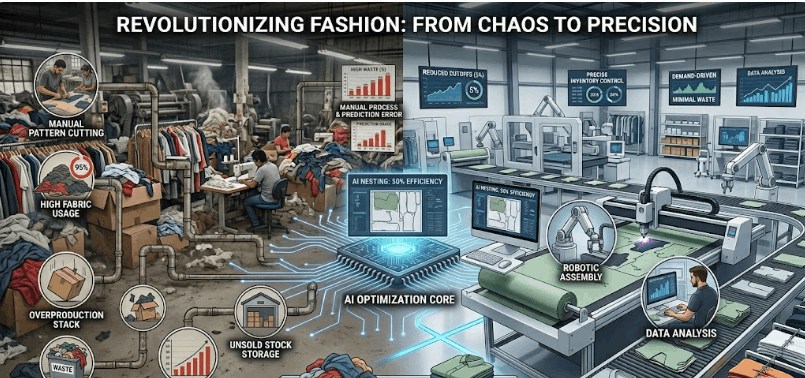

The fashion industry throws away 92 million tons of textile waste every year. That’s the equivalent of one garbage truck of clothing dumped into a landfill every single second. And if you’ve been reading about “sustainable fashion” for the past few years, you’ve probably noticed something frustrating: most of those articles are still talking about organic cotton and reusable tote bags.
That conversation is over.
As a sustainability-focused fashion analyst who’s tracked this industry since the early 2010s, I can tell you that what’s happening in 2026 is fundamentally different. We’re not talking about trends anymore. We’re talking about circular systems, built on bio-fabricated materials, radical supply chain transparency, and AI-driven production models that are quietly dismantling the overproduction machine that’s been fashion’s worst-kept secret for decades.
Sustainable clothing in 2026 refers to garments designed, produced, and distributed within systems that minimize environmental harm while maximizing material reuse and supply chain transparency. It encompasses bio-based textiles, circular business models like resale and rental, AI-optimized production, and digitally verified ethical sourcing through tools like Digital Product Passports (DPPs). Unlike earlier iterations focused on single-material swaps, the 2026 model treats the entire garment lifecycle as an interconnected system, from raw material to end-of-life recycling.
If you’re still thinking “sustainable fashion” means paying $80 for an organic t-shirt, buckle up. The reality is far more interesting, far more complex, and far more consequential than most people realize.
Page Contents
The Death of “Greenwashing”: Why Radical Transparency is Non-Negotiable
Here’s a number that should make every fast fashion executive sweat: by mid-2027, every textile product sold in the European Union will need a Digital Product Passport. Not a marketing label. Not a vague “eco-friendly” tagline. A scannable, verifiable, machine-readable record of that garment’s entire life story, from the field where the fiber was grown to the factory where it was stitched.
The EU’s Ecodesign for Sustainable Products Regulation (ESPR), which came into force in July 2024, created the legal backbone for this shift. The delegated act for textiles is expected in late 2026 or early 2027, followed by an 18-month compliance window. That means brands selling into the EU market are already scrambling to map their Tier 1 through Tier 4 suppliers, standardize material data, and select DPP platforms.
And this isn’t just a European problem. China is building a parallel state-administered DPP system targeting 2027 implementation. The U.S. hasn’t mandated anything federally, but any brand exporting to the EU must comply regardless of where they’re headquartered.
So what does a DPP actually contain? Think of it as a garment’s birth certificate, medical history, and autopsy report rolled into one. Each product gets tagged with a QR code or NFC chip. Scan it, and you’ll see detailed fiber composition, chemical treatments used, water consumption metrics, factory locations, worker welfare documentation, and end-of-life recycling instructions.
For consumers, this is a game-changer. You’ll no longer need to trust a brand’s marketing claims. You can verify them in seconds from your phone.
For brands? The ones who’ve been hiding behind vague sustainability reports are in trouble. Transparency isn’t optional anymore. And the ones who embrace it early, companies like Coverguard, which uses its DPP as a competitive differentiator, are already seeing stronger customer loyalty and higher conversion rates.
(Trust me, I’ve watched brands pivot from “this is annoying compliance” to “wait, this is actually a sales tool” in record time.)
How can consumers verify ethical supply chains in 2026? Consumers can scan QR codes or NFC tags on garments to access Digital Product Passports, which display verified data about material origins, factory locations, chemical usage, and labor conditions. Unlike traditional labels, DPPs provide machine-readable, updatable records that can be checked against third-party certifications in real time.
Next-Gen Bio-Materials: Beyond Organic Cotton
Let’s be honest about organic cotton for a second. Yes, it eliminates synthetic pesticides. But it still uses enormous amounts of water, roughly 10,000 liters per kilogram. And it accounts for less than 1% of global cotton production. If organic cotton is the answer to fashion’s environmental crisis, we’ve been asking the wrong question.
The materials revolution happening in 2026 goes far beyond swapping conventional fibers for organic ones. We’re seeing commercial-scale adoption of textiles that, five years ago, existed only in labs.
Mycelium (mushroom) leather is the headline grabber, and for good reason. Companies like Bolt Threads and MycoWorks have moved from experimental batches to production-ready materials that mimic the look, feel, and durability of animal leather. The process grows leather-like sheets from the root structure of mushrooms, using agricultural waste as a feedstock. The result? A material that biodegrades naturally, requires a fraction of the land and water of cattle farming, and avoids the toxic chromium tanning process used in conventional leather production.
Then there’s algae-based textiles. Algae grows incredibly fast, absorbs carbon dioxide as it develops, and can be processed into fibers without the petrochemical inputs required for synthetic materials like polyester. Several startups are now producing algae-derived yarns that work in existing textile manufacturing equipment, which means brands don’t need to overhaul their entire production infrastructure to adopt them.
Regenerative agriculture is another front that’s gaining real traction. This goes beyond “sustainable” farming (which aims to do less harm) to farming that actively improves soil health, sequesters carbon, and restores biodiversity. Brands partnering with regenerative cotton and wool farms are producing fibers that function as carbon sinks rather than carbon sources. The Textile Exchange’s 2025 report showed a 40% year-over-year increase in brands committing to regenerative fiber sourcing.
And then there’s the recycling technology piece, which might be the most underappreciated part of this equation. Fiber-to-fiber recycling, the process of breaking down old garments into raw materials that can be spun into new textiles, has historically struggled with blended fabrics. A cotton-polyester blend, which represents a huge chunk of the world’s clothing, was essentially unrecyclable. New enzymatic and chemical recycling processes developed by companies like Renewcell and Circ are cracking that problem, enabling separation and recovery of individual fiber types from complex blends.
What are the best bio-based materials for eco-friendly clothing? The leading bio-based materials in 2026 include mycelium leather (grown from mushroom roots), algae-derived fibers, pineapple leaf textile (Pinatex), and regenerative wool and cotton. These materials offer lower water usage, reduced chemical inputs, and natural biodegradability compared to conventional synthetics like polyester or traditional leather.
| Feature | Traditional (Linear) Fashion | Circular Fashion (2026) |
|---|---|---|
| Design Philosophy | Trend-driven, planned obsolescence | Durable, modular, designed for disassembly |
| Material Source | Virgin fibers (polyester, conventional cotton) | Bio-based, recycled, regenerative fibers |
| Production Model | Mass production based on forecast | AI-optimized, demand-driven, on-demand |
| Transparency | Marketing claims, voluntary labels | Digital Product Passports, verified data |
| End-of-Life | Landfill or incineration | Fiber-to-fiber recycling, composting, resale |
| Consumer Role | Buy, wear, discard | Rent, resell, return, repair |
| Waste Output | 92 million tons annually | Closed-loop targets: near-zero waste |
How AI and Virtual Try-Ons are Ending Overproduction
Here’s the elephant in the room that most sustainability articles ignore: overproduction is the single biggest environmental crime in fashion. Not plastic packaging. Not synthetic dyes. Overproduction.
The fashion industry produces roughly 100 billion garments per year for a global population of 8 billion people. That’s about 14 garments per person annually, and roughly 30% to 40% of those garments are never sold at full price. They end up in outlet stores, shipped to developing countries, or incinerated.
No amount of organic cotton fixes this math. But AI might.
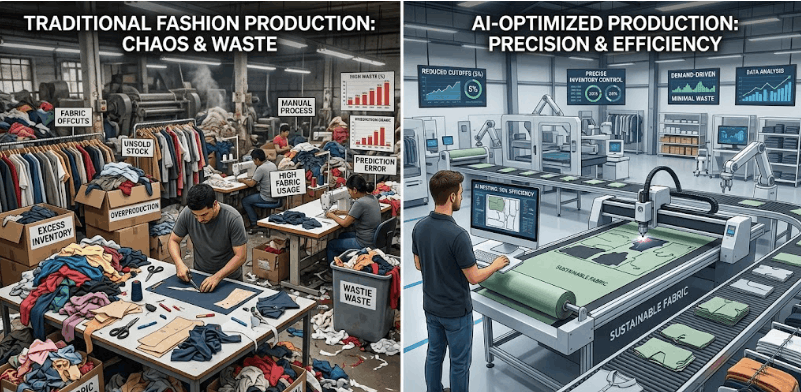
The AI fashion market reached $3.99 billion in 2026, growing at 39% annually according to McKinsey. And the most impactful application isn’t flashy customer-facing chatbots. It’s happening in the back office: demand forecasting, inventory optimization, and virtual prototyping that are fundamentally restructuring how many garments get made in the first place.
Take H&M’s partnership with Google Cloud. Their AI-driven supply chain management platform integrates data from sales channels, warehouses, social media trends, weather patterns, and local events to generate precise demand forecasts. The results by Q3 2025 were staggering: a 9% inventory reduction, a 40% jump in operating profit, and gross margins improving to 52.9%. Less overproduction, more profit. That’s the kind of math that gets boardrooms to pay attention.
In February 2026, ASOS embedded generative AI across its design operations, upskilling over 100 designers. The technology lets creative teams explore colorways, fabric choices, and silhouette variations digitally before committing to physical samples, achieving 75 to 80% time savings across key design processes and significantly reducing sample waste.
On the consumer side, AI virtual try-on technology is tackling the other side of overproduction: returns. The online apparel return rate hit 24% globally in 2025, climbing to nearly 40% for online-only purchases. A huge chunk of those returns happen because the fit was wrong or the color looked different on screen.
In January 2026, Zara introduced interactive virtual try-on experiences. Brands using AI try-on tools are seeing 15 to 35% conversion lifts and 20 to 30% return reductions. Google’s experimental virtual try-on app, Doppl, is being folded directly into Google product listings and search results, which means virtual try-on is becoming search infrastructure rather than a nice-to-have feature.
Every returned garment gets shipped back, reprocessed, repackaged, and often ends up marked down or discarded. Reducing returns by 30% across the industry would eliminate millions of tons of transportation emissions and packaging waste annually. AI isn’t a sustainability buzzword here. It’s a structural solution to a structural problem.
How does AI reduce overproduction in fashion? AI reduces overproduction through three mechanisms: predictive demand forecasting that matches production to actual consumer demand, virtual prototyping that eliminates physical sample waste, and virtual try-on technology that reduces returns by helping shoppers visualize fit before purchasing. Leading brands like H&M have achieved 9% inventory reductions using AI-driven supply chain platforms.
Investing in the Future: The Growth of the Resale and Rental Economy
The secondhand clothing market is projected to account for 10% of global fashion sales, and industry analysts expect the sector to grow two to three times faster than traditional retail through 2027. That’s not a niche. That’s a structural shift.
What changed? Several things converged at once.
Consumer attitudes flipped. Repeating outfits, even among celebrities, went from faux pas to flex. Thrifting stopped being something people did quietly and became a status symbol, especially among Gen Z consumers who see vintage finds as more authentic than anything off a fast fashion rack.
Brands got smart. Instead of treating the resale market as a competitor, forward-thinking companies launched their own recommerce platforms. Zara Pre-Owned. Patagonia’s Worn Wear program. MUD Jeans, which pioneered a leasing model for denim. These brands realized that owning the resale channel meant controlling the customer relationship long after the initial purchase.
And technology made it practical. AI-powered authentication tools verify product condition and value. Integrated resale platforms handle logistics, pricing, and quality control. The friction that used to make secondhand shopping a hassle, inconsistent sizing, questionable quality, limited selection, has been engineered away.
The rental economy is following a similar trajectory. Fashion rental services let consumers access high-quality, designer-level wardrobes for a fraction of the purchase price. For special occasions, this model is almost inarguably better than buying a dress you’ll wear once and shove in the back of your closet. For everyday wear, subscription-based rental services are normalizing the idea that you don’t need to own every garment you wear.
But let me add a reality check here. The circular economy isn’t a silver bullet. Shipping garments back and forth for rental creates its own carbon footprint. Not every material is recyclable. And the energy required for fiber-to-fiber recycling processes isn’t trivial.
The honest take? Circular fashion dramatically reduces waste compared to the linear model, but it’s not zero-impact. The goal isn’t perfection. It’s progress. And the progress from 2020 to 2026 has been remarkable.
What role do smart textiles play in reducing garment waste? Smart textiles embedded with sensors can monitor garment condition, predict wear patterns, and signal optimal timing for repair or recycling. Combined with Digital Product Passports, these technologies extend garment lifespans and improve fiber recovery rates by providing accurate material data to recyclers at end-of-life.
The Role of Digital Product Passports in Sustainable Fashion
Digital Product Passports deserve their own focused discussion because they represent the single most transformative regulatory development in fashion sustainability this decade.
The concept is straightforward: every garment gets a digital identity. But the implications are enormous. DPPs create a shared data layer that connects brands, consumers, resellers, recyclers, and regulators around verified product information.
For recyclers, this is huge. One of the biggest barriers to textile recycling has been uncertainty about fiber composition. A garment label might say “cotton blend,” but what kind of blend? What chemicals were used in finishing? What adhesives hold the trim? DPPs provide precise, machine-readable answers to these questions, enabling automated sorting and processing that makes large-scale recycling economically viable.
For resale platforms, DPPs provide authentication and provenance data that increases buyer confidence and command premium pricing on secondhand goods.
For regulators, DPPs create an audit trail that makes enforcement of environmental standards practical rather than theoretical.
The European Commission estimates that over 80% of a product’s environmental impact is determined at the design stage. DPPs create a feedback loop: designers can see how their material choices affect end-of-life recyclability, and adjust future designs accordingly.
Early movers aren’t waiting for enforcement deadlines. Brands like Ganni, Dondup, and several luxury houses are already implementing DPPs as competitive advantages, using transparency as a trust-building tool with environmentally conscious consumers.
FAQs
What is the environmental footprint of circular fashion vs. fast fashion? Circular fashion models reduce carbon emissions by 30 to 70% compared to traditional linear production, primarily by extending garment lifespans and displacing virgin material extraction. Fast fashion’s footprint includes overproduction waste, petrochemical-based synthetics, water-intensive dyeing processes, and landfill decomposition emissions. Circular approaches address each of these through design-for-disassembly, bio-materials, closed-loop water systems, and fiber-to-fiber recycling.
How do consumers verify ethical supply chains in 2026? Through Digital Product Passports, consumers scan QR codes or NFC tags on garments to access verified supply chain data, including material origins, factory certifications, labor condition audits, and chemical usage records. This replaces reliance on marketing claims with machine-readable, third-party-verified information.
What are the benefits of upcycled and regenerated fabrics? Upcycled fabrics divert textile waste from landfills and reduce demand for virgin materials. Regenerated fabrics, such as those from Renewcell’s Circulose process, break down post-consumer cotton into dissolving pulp that gets respun into new viscose fibers, maintaining quality while closing the material loop. Consumers benefit from lower environmental impact without sacrificing garment performance.
How much does sustainable clothing actually cost? Price premiums have narrowed significantly as sustainable production scales. In 2026, basic sustainable staples like organic cotton t-shirts and recycled polyester activewear are priced within 10 to 20% of conventional equivalents. Higher-end bio-fabricated materials like mycelium leather still carry premiums of 30 to 50%, but costs are declining with production scale.
What is the future of textile recycling technology? Enzymatic and chemical recycling processes now enable fiber-to-fiber recovery from blended fabrics, which was previously impossible. Investment in textile recycling infrastructure grew 60% between 2023 and 2025. The EU’s Extended Producer Responsibility frameworks will further incentivize brands to fund collection and recycling infrastructure for their own products.
Can AI really make fashion sustainable? AI is a tool, not a solution by itself. But when applied to demand forecasting, virtual prototyping, supply chain optimization, and virtual try-on technology, AI addresses the structural overproduction problem that individual consumer choices alone cannot fix. Brands using AI-driven production models have reduced excess inventory by 20 to 30%.
What Happens Next
After a decade of studying this space, here’s what I’ve learned matters most:
The technology exists. Bio-materials, AI forecasting, Digital Product Passports, fiber-to-fiber recycling. These aren’t theoretical. They’re deployed, scaling, and improving every quarter.
The regulation is coming. The EU’s ESPR and DPP mandates represent the most significant sustainability legislation in fashion history. Brands that treat compliance as an afterthought will get caught flat-footed. Those that treat it as strategy will gain a durable competitive edge.
But the missing piece is still consumer behavior. All the innovation in the world doesn’t matter if people keep buying 14 garments a year and wearing each one seven times before tossing it.
Whether you’re a conscious shopper looking to make better choices or a brand leader navigating the circular fashion transition, the playbook is clear: buy less, choose bio-based and recycled materials, verify claims through DPPs, and support brands that are designing for end-of-life from day one.
The fashion industry’s environmental reckoning isn’t coming. It’s here. And for the first time, the tools to actually fix it are here too.



Pingback: A Guide to Budget Traveling: Tips for Affordable Adventures